Introduction: Emission monitoring as a strategic enabler for Indian fertilizer plants
Fertilizer production in India operates at the intersection of complex chemical processes, high energy intensity, and stringent regulatory expectations. To stay competitive while protecting the environment, plants need accurate, continuous visibility into their emissions. Advanced optical CEMS based on DOAS and TDL technology offer a scalable solution that delivers real‑time, multi‑gas data without the interruptions commonly associated with traditional sampling systems.
What makes advanced CEMS essential for fertilizer operations
Continuous Emission Monitoring Systems that use differential optical absorption spectroscopy (DOAS) coupled with Tunable Diode Laser (TDL) sensing bring several core advantages to large scale fertilizer facilities:
- Real‑time measurements of critical pollutants such as NH3, NOx, and SO2, plus other trace gases.
- On‑stack and cross‑stack measurement capabilities for robust process visibility.
- Minimal maintenance requirements due to non‑sampling technology, reducing downtime and lifecycle costs.
- Direct support for regulatory compliance with CPCB and GPCB reporting standards.
How DOAS/TDL CEMS work in practice
DOAS analyzes broad spectral features to quantify multiple gas species from a single optical path, while TDL sensors provide highly selective measurements for specific gases. In fertilizer plants, this combination enables simultaneous monitoring of NH3 and acid gases alongside NOx and SO2. The system typically features on‑stack installation with cross‑stack optical paths that capture representative emission streams, ensuring data accuracy under diverse production conditions.
Key parameters typically monitored
A modern OPSIS DOAS/TDL CEMS suite can track:
- Ammonia (NH3)
- Nitrogen oxides (NOx)
- Sulfur dioxide (SO2)
- Other selected gases and particulates as required by local regulations
Case example: IFFCO at Kandla, Gujarat
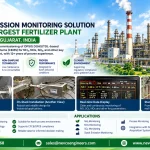
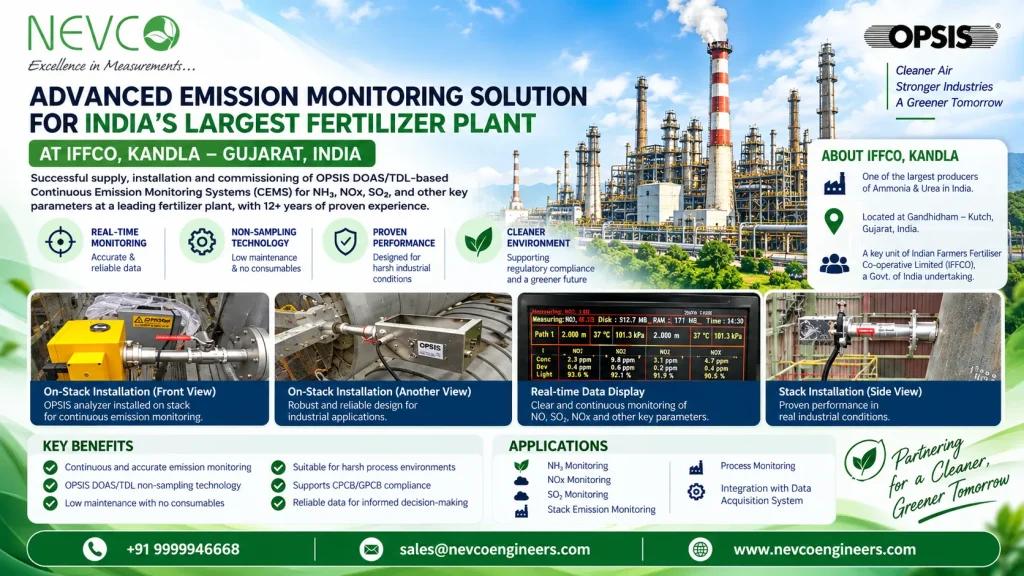
Recent deployments in India demonstrate the practical value of this technology. A leading fertilizer producer engaged an engineering partner to supply, install, and commission OPSIS DOAS/TDL based CEMS at a major facility in Kandla. The project highlights include:
- On‑stack installation with cross‑stack optical measurement to capture representative emissions
- Real‑time emission data display for operators and management dashboards
- Continuous monitoring of NH3, NOx, SO2 and additional gases for comprehensive environmental oversight
- Low‑maintenance, non‑sampling architecture suitable for demanding industrial environments
- Compliance support aligned with CPCB/GPCB requirements
Benefits realized for Indian fertilizer plants
Adopting advanced optical CEMS translates into tangible improvements across operations and compliance:
- Enhanced process visibility enabling tighter process control and efficiency gains
- Consistent, auditable emission data that simplifies regulatory reporting
- Reduced maintenance downtime compared with traditional sampling systems
- Better environmental stewardship through accurate monitoring of priority pollutants
Implementation considerations for Indian facilities
To maximize value from an OPSIS DOAS/TDL CEMS deployment, consider the following best practices:
- Define a clear data management plan including real‑time dashboards and historical data retention
- Align the system with CPCB and GPCB regulatory frameworks from the outset
- Plan for robust on‑stack installation and cross‑stack pathway validation to ensure representative sampling
- Establish calibration and maintenance schedules that minimize downtime
- Integrate CEMS data with plant control systems for closed‑loop process optimization
Future-ready monitoring: trends and opportunities
Beyond compliance, advanced CEMS unlock opportunities in process optimization, energy management, and sustainability reporting. As Indian industries pursue cleaner production goals, integrating DOAS/TDL data with digital twins, AI analytics, and enterprise dashboards will become more common, enabling proactive maintenance and smarter decision‑making.
Conclusion: Cleaner production through reliable measurement
Advanced optical emission monitoring, exemplified by OPSIS DOAS/TDL CEMS, offers fertilizer producers a scalable, low‑maintenance path to real‑time, multi‑gas visibility. By delivering accurate NH3, NOx, and SO2 data with cross‑stack capability and regulatory alignment, these systems empower Indian industry to improve operations, ensure compliance, and advance toward cleaner, more sustainable production.
About NEVCO Engineers
NEVCO Engineers partners with leading process industries to implement proven measurement technologies and dependable environmental monitoring solutions. Their expertise helps facilities achieve reliable emission data and better operational awareness for responsible growth.