Why precise flow data matters for water management
In water-resource management, accurate measurements of river and open-channel discharge are foundational. Reliable flow data informs hydraulic models, supports flood forecasting, guides reservoir operations, and underpins environmental monitoring. When data quality is high, decisions about diversions, water allocations, and ecological protections are more proactive and effective.
Understanding side-looking Doppler current meters
Side-looking Doppler current meters use acoustic signals emitted from a transducer that looks to the side of the instrument. By measuring the Doppler shift of echoes scattered from moving particles in the water, these devices estimate velocity components across a cross-section. Compared with traditional transect sondes or wall-mounted gages, side-looking configurations excel in challenging environments where deployment depth, debris, or access limitations would otherwise hinder reliable measurements. With multiple sampling depths and combined velocity estimates, they deliver robust cross-sectional discharge data even in turbid or turbulent flows.
Meet the SL1500: a reliable, rugged choice for difficult environments
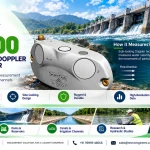
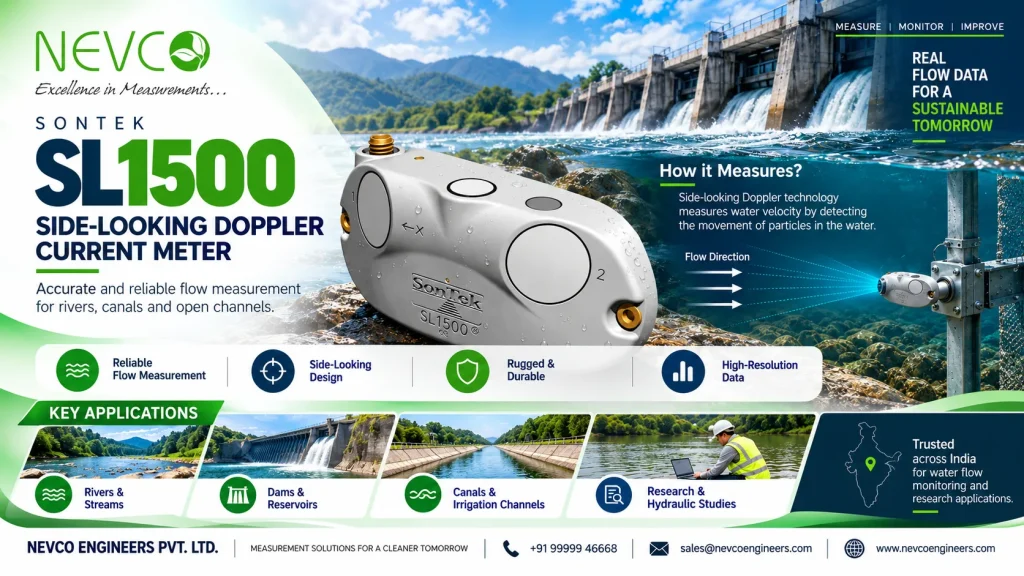
The SL1500 is designed to deliver dependable flow information in rivers, streams, canals, and reservoir intakes. Its side-looking geometry helps in reach locations where conventional sensors struggle, while its rugged construction stands up to field conditions. Key advantages include:
- Reliable flow measurement across diverse cross-sections
- Side-looking Doppler technology optimized for complex channels
- Rugged, field-ready housing with weatherproof sealing
- High-resolution velocity data enabling finer discharge estimates
- Versatility for rivers, streams, canals, and reservoirs
- Well-suited for hydraulic and environmental monitoring programs
Deployment playbook: getting the most from a side-looking Doppler meter
Site selection and mounting considerations
Choose locations that provide representative cross-sections with minimal obstruction and clear paths for the acoustic beam. Consider secure mounting on fixed platforms, pilings, or stable vessels. Ensure the instrument is oriented to minimize bank interference and shadowing effects from riprap or vegetation. Plan for power and data retrieval, with redundancy where possible to maintain continuous monitoring during events.
Installation tips for accuracy and longevity
Install the sensor so that the transducers maintain a clear acoustic path. Seal connections against moisture, and protect cables from abrasion. If fouling is expected, schedule regular cleaning and use anti-fouling strategies. Calibrate or verify performance against a known cross-section or gauging station to validate velocity profiles and discharge calculations.
From velocity to discharge: turning data into actionable insights
How velocity measurements translate into discharge involves aggregating velocity across the channel cross-section and multiplying by local cross-sectional area. Common approaches include:
- Developing velocity profiles at multiple depths to capture non-uniform flow
- Computing area-weighted mean velocity and then integrating across the cross-section
- Using software tools to convert time-series velocity data into continuous discharge records
Data quality checks are essential: compare with nearby gauging stations, monitor for drift in sensor output, and validate during different flow regimes (low, moderate, high stages). Document QA/QC steps to maintain confidence in the results used for modeling and decision-making.
Side-looking Doppler meters like the SL1500 support a wide range of use cases, including:
- Hydraulic and flood-hlood forecasting through continuous discharge data
- River restoration and sediment transport studies
- Reservoir inflow and outflow monitoring for optimized storage
- Environmental monitoring programs tracking habitat flows and pollutant transport
- Operational guidance for hydropower intakes and canal regulation
Field devices must withstand harsh conditions. Plan for routine cleaning to minimize biofouling, check seals and connectors, and manage battery life or power supply reliability. Establish data back-ups and a maintenance calendar to reduce downtime. A rugged, modular design simplifies field servicing and component replacement when needed.
Why NEVCO Engineers: measurement solutions that empower you
NEVCO Engineers specializes in advanced water measurement solutions, helping professionals measure, monitor, and improve water systems. Whether deploying side-looking Doppler meters for complex channel conditions or integrating data into hydraulic models, their teams provide technical support, installation guidance, and training to ensure you gain maximum value from your instrumentation.
Conclusion: Measure, monitor, improve
Accurate flow data is a cornerstone of effective water management. By leveraging side-looking Doppler technology, robust sensors like the SL1500, and a disciplined deployment and QA approach, organizations can achieve more reliable discharge estimates, better forecasts, and smarter decision-making. If you’re evaluating flow measurement solutions, start with a well-planned deployment, rigorous data validation, and a partner who can translate data into actionable outcomes. Measure the flow, monitor the system, and drive improvements in water resource management.