In today’s regulatory landscape, industries face increasing pressure to monitor and control their emissions with precision. Continuous Emission Monitoring Systems (CEMS) are essential tools that help organizations maintain regulatory compliance, optimize processes, and make informed environmental decisions through reliable, real-time emission data.
However, not every application requires the same measurement approach. Selecting the right CEMS method depends on multiple factors, including gas properties, stack conditions, moisture levels, required accuracy, and specific monitoring requirements. Understanding these options is crucial for industries striving to balance operational efficiency with environmental responsibility.
At NEVCO Engineers, we provide advanced environmental monitoring solutions designed to help industries achieve accurate measurement, smarter decisions, and a greener tomorrow. Let’s explore the key CEMS measurement methods to help you determine the best fit for your application.
Understanding CEMS Measurement Methods
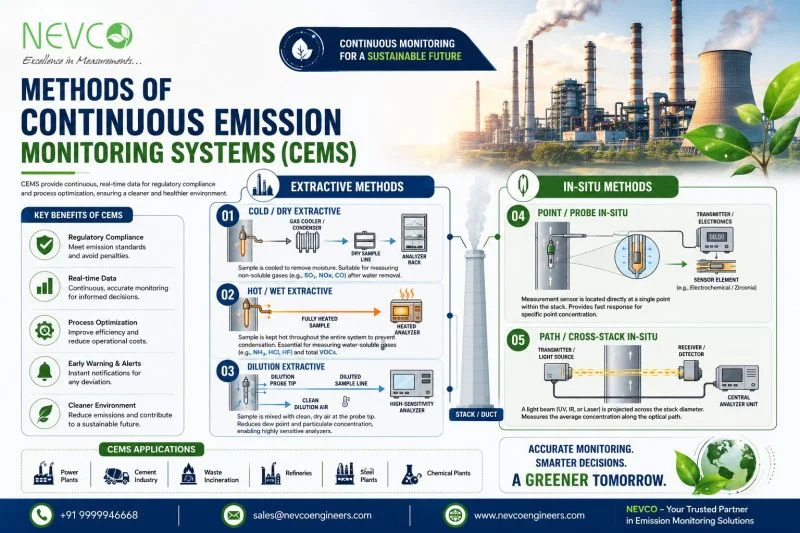
Continuous Emission Monitoring Systems generally fall into two primary categories: Extractive Methods and In-Situ Methods. Each offers distinct advantages depending on the application.
1. Extractive Methods
Extractive CEMS draw a representative sample of flue gas from the stack and transport it through a conditioned system to an analyzer. These methods offer flexibility in analyzer placement and are suitable for a wide range of applications.
🔹 Cold / Dry Extractive
In this approach, the sample gas is cooled to remove moisture (condensation) before analysis. The gas is conditioned to a “dry” state, and the concentration of pollutants is reported on a dry basis.
- Best For: Applications with low moisture content and where dry-basis reporting is required.
- Advantages: Protects analyzers from moisture-related damage; well-established technology.
- Considerations: May lose water-soluble components like HCl and HF during the drying process; requires effective sample conditioning.
🔹 Hot / Wet Extractive
This method keeps the sample gas at an elevated temperature throughout the transport and analysis process, ensuring all components remain in a gaseous state.
- Best For: Applications with high moisture content and where measuring total (wet basis) concentrations is essential.
- Advantages: Provides a more representative measurement of actual stack conditions; enables accurate measurement of reactive and water-soluble species such as HCl, HF, and NH₃.
- Considerations: Requires heated sample lines, filters, and analyzers, increasing system complexity and cost.
🔹 Dilution Extractive
In dilution extractive systems, a precisely controlled flow of clean, dry air is mixed with the sample gas at the sampling point, significantly reducing the concentration of pollutants and moisture before analysis.
- Best For: High-particulate and high-moisture environments.
- Advantages: Minimizes sample transport problems such as condensation; reduces sample line plugging and maintenance; with proper conditioning, can provide nearly dry gas to the analyzer.
- Considerations: Demands very precise and stable dilution control to maintain accuracy; requires challenging calibration verification and quality assurance due to the low pollutant concentrations after dilution.
2. In-Situ Methods
In-situ CEMS place the measurement equipment directly within the stack or duct, allowing the monitoring of emissions without extracting a sample. There are two primary configurations.
🔹 Point / Probe In-Situ
A probe is inserted directly into the stack to measure gas concentrations and other parameters at a single, localized point.
- Best For: Homogeneous gas streams or smaller-diameter stacks.
- Advantages: Minimal sample transport and conditioning; typically lower initial equipment costs.
- Considerations: May not provide a fully representative sample in stratified or non-uniform flow conditions; ongoing zero/span gas checks can be challenging due to potential fouling.
🔹 Path / Cross-Stack In-Situ
This method transmits light (or another measurement beam) across the entire diameter of the stack, measuring the average concentration of gases along the path.
- Best For: Large-diameter stacks and ducts, especially for measuring gases like O₂, CO, and CO₂.
- Advantages: Provides a representative average across the stack diameter; non-contact and generally low maintenance; rapid response time.
- Considerations: Requires unobstructed optical path; may be susceptible to misalignment due to thermal expansion or vibration.
Choosing the Right Method for Your Application
Selecting the optimal CEMS method involves careful consideration of several key factors:
- Gas Properties: Are the target gases reactive or water-soluble? Hot/wet extraction may be necessary.
- Stack Conditions: Is the gas stream homogeneous? Path in-situ methods may be better for large or stratified stacks.
- Moisture Content: High moisture levels may favor hot/wet or dilution methods to prevent condensation and loss of soluble components.
- Accuracy Requirements: Regulatory frameworks like the US EPA or European EN standards dictate specific performance criteria that influence method selection.
- Maintenance and Operational Costs: Consider the long-term costs of sample conditioning, consumables, and system maintenance.
Applications Across Industries
CEMS solutions are widely applicable across industries where accurate emission measurement is essential:
- Power Generation: Monitoring NOx, SO₂, CO₂, and particulate emissions from fossil fuel combustion.
- Cement Manufacturing: Tracking emissions from kilns and clinker coolers.
- Waste Incineration: Ensuring compliance with stringent dioxin and heavy metal emission limits.
- Petroleum Refineries: Monitoring VOC, SO₂, and NOx emissions.
- Steel and Metals Production: Measuring emissions from blast furnaces and electric arc furnaces.
- Chemical Manufacturing: Monitoring a wide range of process-specific pollutants.
The NEVCO Engineers Advantage
At NEVCO Engineers, we understand that selecting the right CEMS solution is critical for achieving accurate measurement, smarter decisions, and a cleaner future. Our team of experts works closely with clients to evaluate their specific application needs, guiding them through the selection, installation, and ongoing support of their monitoring systems.
We are proud to offer advanced environmental monitoring solutions designed to help industries:
- Maintain regulatory compliance with confidence.
- Optimize process efficiency through real-time data.
- Make informed decisions that reduce environmental impact.
- Build a reputation for environmental stewardship.
Ready to Find Your Ideal CEMS Solution?
Choosing the right CEMS method is the first step toward reliable emission monitoring and a cleaner tomorrow. Whether you need an extractive system for a high-moisture application or an in-situ solution for a large-diameter stack, NEVCO Engineers has the expertise to help you succeed.
📩 Connect with us today to explore the right emission monitoring solution for your application.