Introduction: The Low-Entropy Path to Cleaner Industry
In today’s industrial landscape, every ton of emissions matters. Beyond compliance, modern facilities seek actionable insights that improve process efficiency, reduce waste, and protect environmental health. Multi-component gas analysis emerges as a powerful approach, enabling you to track multiple gas species simultaneously rather than relying on single-gas snapshots. This article explores why this capability matters, the science behind it, and practical guidance for leveraging multi-component analysers to achieve cleaner emissions and smarter operations.
What is multi-component gas analysis?
Multi-component gas analysis refers to instruments and systems that quantify several gas species within a single, integrated measurement. Instead of measuring one gas at a time, these analysers capture a wider gas profile in real time, offering a more complete view of a process stream. Advanced optical technology makes this possible by detecting how different gas molecules interact with light across specific wavelengths, allowing concurrent identification and concentration calculation of multiple species.
Key technology foundations
- Optical spectroscopy that targets multiple absorption bands corresponding to different gases
- Algorithms that deconvolve overlapping spectra to separate signals from coexisting species
- Real-time data processing for fast decision making and process control
- Robust calibration against traceable standards to ensure accuracy across a range of operating conditions
Why multi-component analysis matters for emissions
Relying on a single gas measurement can mask important interactions and limit your ability to manage emissions effectively. Multi-component analysis delivers several advantages:
- Comprehensive emissions profiling by capturing major and trace gases in one measurement
- Improved accuracy through cross-species calibration and spectral fitting
- Faster decision cycles for process adjustments, maintenance planning, and regulatory reporting
- Enhanced transparency for environmental monitoring and corporate sustainability reporting
Performance and resilience: what to expect from a modern analyser
Modern multi-component analysers are designed to deliver high measurement performance in demanding industrial environments. Look for:
- Simultaneous multi-gas measurement with high spectral sensitivity
- Fast response times and stable long-term drift characteristics
- Rugged construction that withstands dust, heat, humidity, and vibration
- Low maintenance needs and straightforward calibration routines
Practical applications across industries
Different sectors can benefit from the rich insights provided by multi-component analysers. Common use cases include:
- Petrochemical and refinery operations monitoring CO, CO2, CH4, NOx, SO2, and VOCs to optimize combustion and reduce fugitive emissions
- Power generation facilities trackingNOx, SO2, CO2, and hydrocarbons for compliance and performance optimization
- Cement and metal industries where complex gas mixtures are produced and need real-time profiling
- Industrial ventilation and air quality monitoring in large facilities to ensure worker safety and regulatory adherence
AR650 Series as a case in point
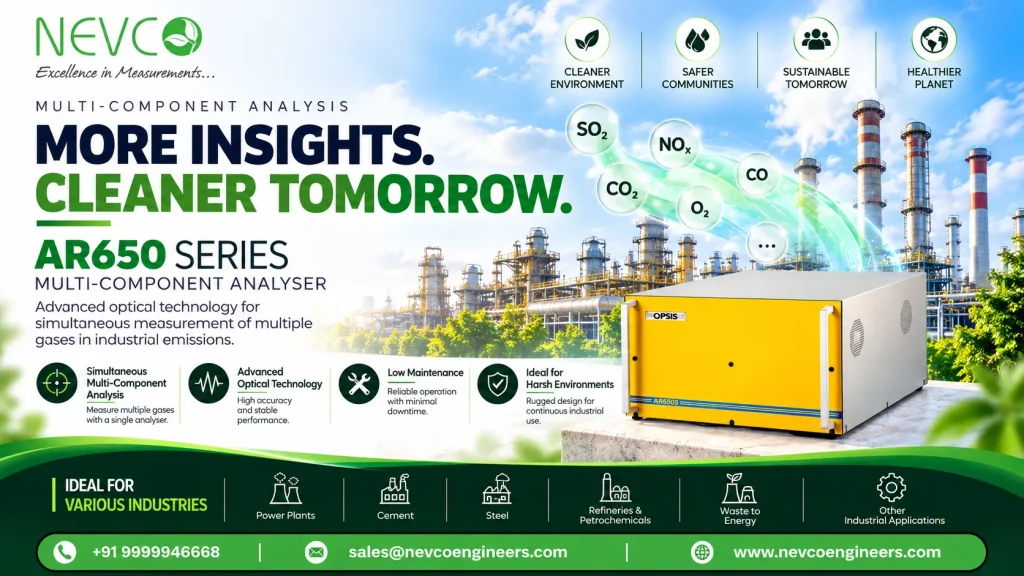
While many systems exist, the AR650 Series Multi-Component Analyser serves as a representative model of how advanced optical technology can enable simultaneous gas measurements with high accuracy in harsh environments. Features typically highlighted include multi-gas capabilities, robust optical measurement, high measurement performance, and a design attuned to demanding industrial settings. The takeaway is not a specific product, but the demonstrated value of integrated gas profiling for emissions insights and process management.
How to implement multi-component analysers effectively
Successful deployment requires careful planning and ongoing management. Consider the following steps:
- Define the gas matrix: identify the priority gases to measure based on process chemistry, regulatory requirements, and risk factors
- Assess installation points: choose sampling locations that reflect representative process streams and minimize line losses
- Plan calibration and validation: establish traceable standards, regular calibration intervals, and cross-checks with reference methods
- Ensure data integration: connect with your emissions reporting, SCADA, or environmental management system for seamless data flow
- Develop maintenance routines: schedule filter changes, optics cleaning, and network health checks to sustain performance
Best practices for robust emissions monitoring
To maximize value from multi-component analysers, adopt these practices:
- Maintain strict calibration traceability and document all adjustments
- Use redundancy for critical measurements to avoid data gaps
- Monitor spectral quality and drift indicators to catch sensor degradation early
- Incorporate data analytics to translate raw measurements into actionable insights
- Engage in continuous improvement by reviewing emissions data against process performance and energy usage
Overcoming common challenges
Despite their power, multi-component analysers come with challenges. Here are practical solutions:
- Spectral overlap: leverage advanced algorithms and proper spectral libraries to separate signals
- Calibration drift: implement automated drift correction and regular verification with reference methods
- Interferences from particulates: use enhanced filters and proper sample conditioning
- Maintenance burden in harsh environments: select rugged designs and schedule preventive upkeep
The road ahead: trends in gas analysis
Technology continues to evolve. Expect advances in AI-driven data interpretation, more compact and energy-efficient optical components, and greater interoperability with plant digital twins and enterprise analytics. The core goal remains the same: transform complex gas data into precise, actionable emissions insights that drive cleaner operations and better decision making.
Conclusion: Turning insights into cleaner outcomes
Multi-component gas analysis represents a mature, scalable approach to emissions monitoring. By measuring multiple gas species with high accuracy and resilience, industrial facilities gain a fuller understanding of their processes, enabling better environmental performance, compliance, and process optimization. Embrace multi-component analysis as a strategic capability to deliver cleaner tomorrow.