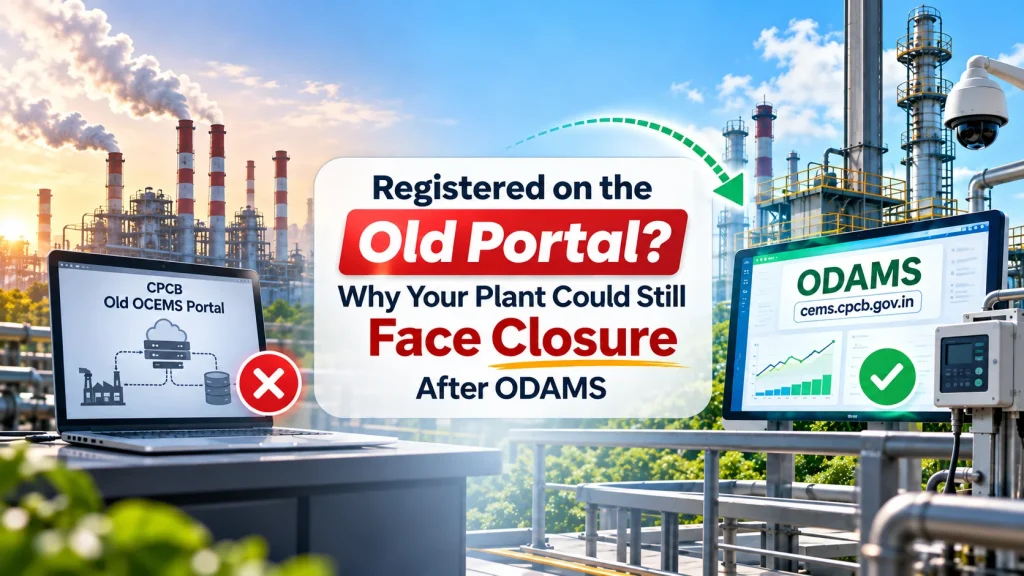
Quick answer: Being registered on CPCB’s old OCEMS portal is no longer enough. CPCB’s new portal, ODAMS (cems.cpcb.gov.in), went live on 31 August 2025, and every industry with OCEMS must register on it and send data directly, without a third-party forwarder. In January 2026, CPCB listed units still on the old portal and directed closure of those that did not register.
Key takeaways
- ODAMS, CPCB’s new OCEMS portal, went live on 31 August 2025 and replaced the 2018 portal that relied on third-party data service providers (TPDS).
- CPCB’s direction dated 23 September 2025 set ODAMS registration deadlines of 15 October 2025 for Delhi-NCR and 15 November 2025 for the rest of India.
- A CPCB direction dated 7 January 2026 listed units connected to the old portal but not registered on ODAMS as of 6 January 2026, and asked SPCBs to close units that did not register by 22 January 2026.
- Registration alone does not close the matter. In March 2026, CPCB found that 462 of 959 Delhi-NCR industries were still not transmitting data on ODAMS.
- Your plant is safe only when your analyser data reaches cems.cpcb.gov.in live, from your own gateway, under your own login.
What changed when CPCB moved from the old OCEMS portal to ODAMS?
CPCB changed how your data reaches it. On the old portal, a vendor’s server sat between your analyser and CPCB. On ODAMS, your plant sends data straight to the CPCB server.
CPCB built its first OCEMS portal in 2018. Under that setup, real-time emission and effluent data travelled from the industry to CPCB through a Third Party Data Service provider, or TPDS. Most plants signed up once, often through their analyser supplier, and never looked at the portal again.
The new portal is called ODAMS (Online Data Acquisition and Management System). As per CPCB’s direction dated 23 September 2025, issued to all SPCBs and PCCs under Section 18(1)(b) of the Water Act and the Air Act, ODAMS was made live on 31 August 2025. Its features include:
- Direct transmission of data from the industry to CPCB servers, with no dependency on a TPDS
- PTZ camera integration
- Data analytics and visualisation for regulators
- A revised OCEMS alert protocol
CPCB demonstrated the portal over video conference on 3 September 2025 to SPCB regional officers in NCR-Delhi, and on 9 September 2025 to industries. The same direction said all industries and common facilities with OCEMS connectivity must register and connect to ODAMS at cems.cpcb.gov.in.
The reasoning is simple. Under the “polluter pays” principle, the industry owns its monitoring and its data. A forwarder in the middle adds another point where data can be delayed, filtered, or lost. If your systems were set up under the earlier CPCB guidelines for OCEMS, the hardware may still be fine, but the data route has to change.
Old portal vs ODAMS: what changed for your plant
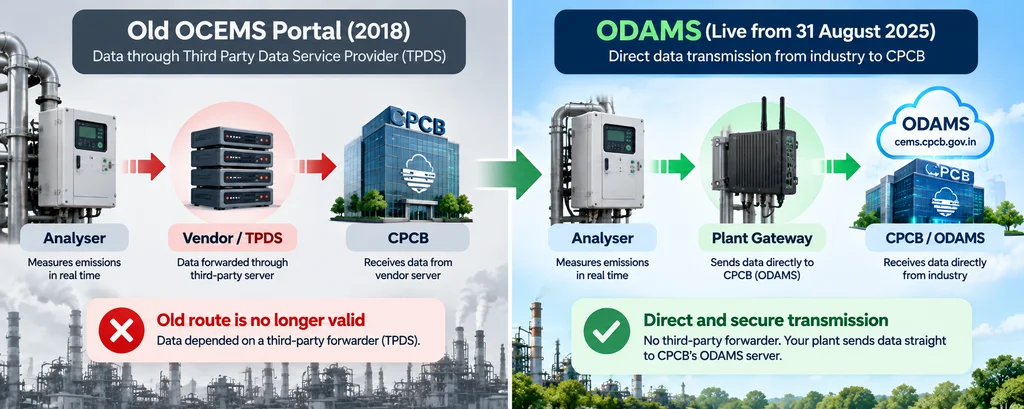
The biggest change for a plant head is responsibility. On ODAMS, if data stops, there is no vendor to blame on paper. Your unit’s name is on the station.
| Point | Old OCEMS portal (2018) | ODAMS (live from 31 August 2025) |
| Web address | Earlier CPCB OCEMS portal | cems.cpcb.gov.in |
| Data route | Analyser to vendor (TPDS) server to CPCB | Analyser and gateway direct to CPCB server |
| Who registers | Often done once by the analyser supplier | The industry registers itself, with its own login |
| Field device | Configured for the vendor’s protocol | Must support ODAMS direct transmission, often needing a firmware upgrade or new gateway |
| Camera feed | Handled separately, where required | PTZ camera integration built into the portal |
| Alerts | Earlier alert protocol | Revised OCEMS alert protocol |
| Regulator view | Limited dashboards | Analytics and visualisation for CPCB and SPCBs |
| Status in CPCB directions | Units listed here were listed as defaulters in January 2026 | The portal CPCB now uses for vigilance |
In practice, three things on your site may need attention: the data logger or IoT gateway, the station and parameter mapping, and the login credentials. Our CPCB-connected IoT data logger page explains the hardware side in more detail.
Does ODAMS registration apply to your plant?
If your plant has OCEMS installed, or your consent says you must install it, ODAMS registration applies to you. Being on the old portal does not exempt you. It actually puts you on CPCB’s radar.
Answer yes or no to each line:
- Your unit falls in one of the 17 categories of highly polluting industries, such as cement, thermal power, distillery, sugar, pulp and paper, or fertiliser.
- Your Consent to Operate requires online monitoring of stack emissions or effluent.
- You run a common facility, such as a CETP, with OCEMS connectivity.
- Your unit is a red category air-polluting industry in Delhi-NCR.
- Your plant was connected to the old CPCB portal through a vendor.
One yes means ODAMS applies. If you answered yes to the last line, check today whether your unit is actually registered and transmitting on the new portal.
A quick test you can run with your EHS manager: Do you have your own ODAMS login? Is every stack and outlet visible under your station? Has live data arrived in the last 24 hours? Three yes answers mean you are in reasonable shape.
What deadlines and closure directions has CPCB issued for ODAMS?
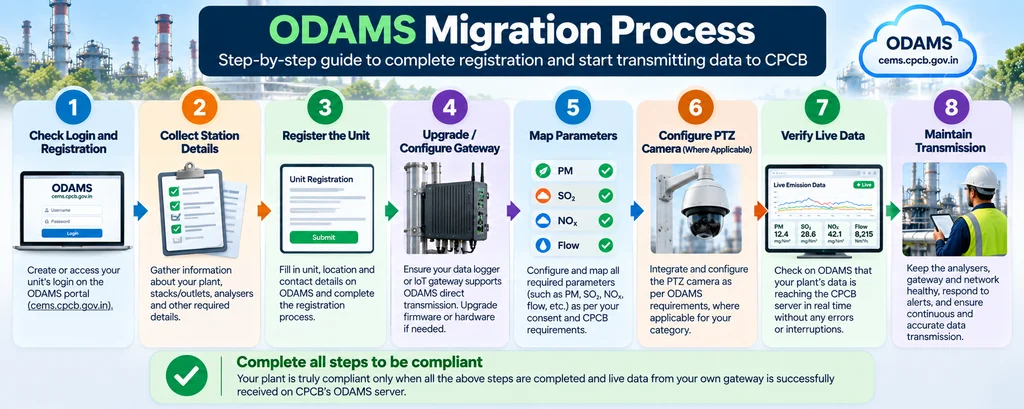
CPCB set registration deadlines in September 2025 and moved to closure directions in January 2026. By March 2026, its focus had shifted from registration to actual data transmission.
| Date | What CPCB did | Source |
| 31 August 2025 | ODAMS made live at cems.cpcb.gov.in | CPCB direction dated 23.09.2025 |
| 23 September 2025 | Directed SPCBs and PCCs to get all OCEMS industries registered and connected to ODAMS | CPCB direction dated 23.09.2025 |
| 15 October 2025 | Registration deadline for Delhi-NCR industries | CPCB direction dated 23.09.2025 |
| 15 November 2025 | Registration deadline for the rest of India | CPCB direction dated 23.09.2025 |
| 7 January 2026 | Listed units on the old portal but not registered on ODAMS as of 6 January 2026. SPCBs to close defaulters not registered by 22 January 2026 | CPCB direction dated 07.01.2026 under Section 18(1)(b) of the Air Act |
| 11 March 2026 | Found 462 of 959 Delhi-NCR industries still not transmitting on ODAMS. Set 26 March 2026 to start transmission, failing which closure | CPCB direction dated 11.03.2026 |
| 25 March 2026 | Extended the March deadline to 11 April 2026 | CPCB letter dated 25.03.2026 |
Two points matter here. First, the January 2026 list was built from units that were already connected to the old portal. CPCB knew exactly who they were. Second, the March 2026 direction covered industries that had migrated on paper but were not sending data. CPCB said in that direction that it needs strict vigilance through the new portal, and a silent station gives it nothing to watch.
The closure itself is issued through your SPCB or PCC. In the January 2026 direction, CPCB asked state boards to file an action-taken report by 8 January 2026 and an updated status of closure directions by 24 January 2026. CPCB and state boards continue to issue follow-up directions, so check your state board’s website and the CPCB website regularly.
How do you complete ODAMS registration and start transmitting?
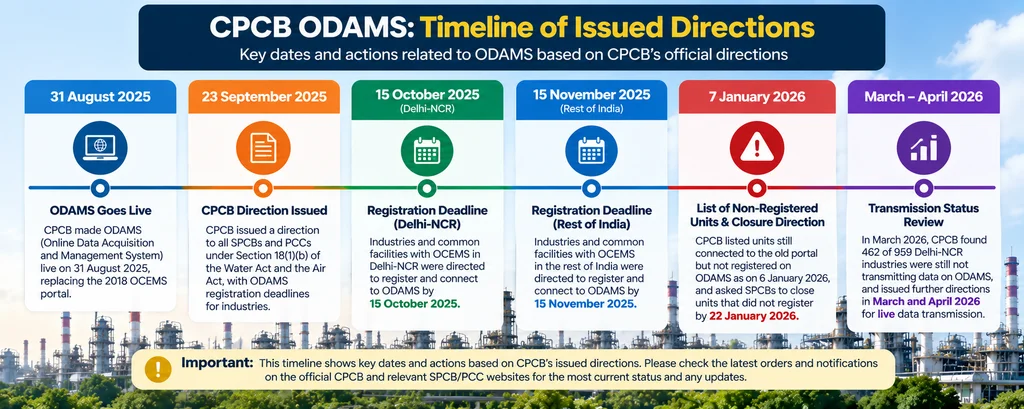
Register your unit at cems.cpcb.gov.in, then make sure your gateway sends live data directly to CPCB. The second part is where most plants get stuck.
- Check your status. Try logging in at cems.cpcb.gov.in. If nobody in your plant has credentials, assume you are not registered.
- Collect your station details. Keep the location coordinates, industry category, consent details, stack and outlet list, and the make, model, and serial number of each analyser.
- Register the unit. Follow the registration procedure published on the ODAMS home page. Use a plant email ID that will not leave with one employee.
- Upgrade the field device. Your data logger or IoT gateway must support ODAMS direct transmission. Older units configured for a TPDS route usually need a firmware upgrade or replacement.
- Map every parameter. Match each parameter, unit, and stack to your consent. For example, SO2, NOx and PM in mg/Nm³, or pH, BOD, COD and TSS at the ETP outlet.
- Connect the PTZ camera, where applicable. ODAMS supports camera integration. Check whether your consent or CPCB direction requires it.
- Verify live data. Watch the portal for 48 to 72 hours. Save screenshots, and obtain a CPCB verification report if your direction asks for one.
- Keep it running. Calibrate as per schedule and respond to portal alerts. Our post on compliance reporting protocols covers this routine.
What mistakes leave plants exposed even after registering?
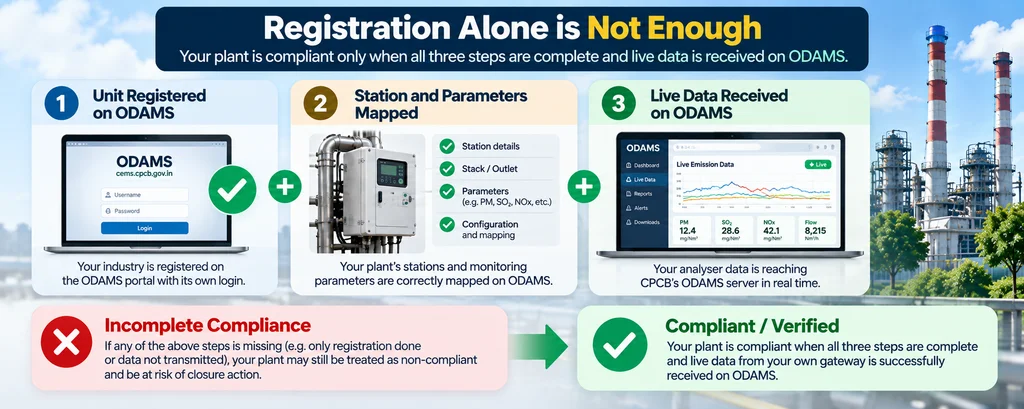
Most exposure comes from assuming the job is done. A registered station that sends no data, or wrong data, looks the same as a defaulter on a CPCB dashboard.
- Trusting the old vendor. The supplier who handled your TPDS link may not have migrated you. Ask for proof, not a phone call.
- Registering but not transmitting. This is the gap CPCB found in March 2026, when nearly half the Delhi-NCR units it checked had no data flowing.
- Flat-line or dead data. A choked probe or failed sample pump still sends a value. A constant reading for hours invites questions.
- Wrong units or mapping. Ppm sent where the consent says mg/Nm³, or two stacks swapped, can create false exceedance alerts.
- Ignoring alerts. Under the revised alert protocol, unanswered alerts build a record against your unit.
- Uncertified analysers in NCR. Through its notification dated 25 November 2025, CPCB allows only CSIR-NPL certified OCEMS to connect to its server for air-polluting industries in NCR, so check your model against CPCB’s current certified list.
A situation we see often. A plant’s control room screen shows healthy readings, and the EHS team believes all is well. When our engineer checks, the data logger is still pointing to the old vendor’s server. Nothing has reached ODAMS for weeks. The fix is usually a firmware change and a fresh registration. Until then, the risk sits there unnoticed.
How Nevco helps you stay connected to ODAMS
We check, fix, and maintain the link between your analysers and the CPCB server, whichever brand you run. Nevco has worked in emission and effluent monitoring since 1982, when we started as Combustion Analysers.
Here is what we bring to an ODAMS migration:
- Field engineers across India. Our 60+ sales and service engineers can visit your site, check the gateway, and confirm what CPCB is actually receiving.
- Repairs for any make. We repair and calibrate instruments even if Nevco did not supply them, with full calibration facilities at our service centres.
- A data logger built to the CPCB protocol. Our NV-LX Series IoT data logger is developed to the latest CPCB communication protocol and transmits data to CPCB and SPCB servers from your own site.
- Proven data capture. Grasim Rehla achieves 99% data capture to CPCB, and Nubiola achieves 100% data capture to CPCB and SPCB.
Our installed base includes 10,000+ flue gas analyzers, 300+ CAAQMS stations and 1,000+ water monitoring stations, for clients such as NTPC, Tata Steel, IFFCO and UltraTech.
Not sure your analyser is connected to ODAMS? Get a free connectivity check. Call +91-9999946668 or write to sales@nevcoengineers.com, Monday to Saturday, 10:00 AM to 6:00 PM.
Frequently asked questions
Is registration on the old CPCB OCEMS portal still valid?
No. CPCB’s direction dated 23 September 2025 requires every industry with OCEMS to register and connect to ODAMS at cems.cpcb.gov.in. In January 2026, CPCB listed units that were on the old portal but had not registered on ODAMS and asked state boards to close defaulters. Old portal registration does not count as compliance.
What is ODAMS?
ODAMS stands for Online Data Acquisition and Management System. It is CPCB’s new OCEMS portal, made live on 31 August 2025 at cems.cpcb.gov.in. It receives emission and effluent data directly from industries without a third-party data service provider, and adds PTZ camera integration, analytics, and a revised alert protocol.
Can my analyser vendor still forward data to CPCB for me?
Not through the old forwarding route. ODAMS is designed for direct transmission from the industry to CPCB servers, without dependency on a TPDS. Your vendor can still help you upgrade the gateway, register the unit, and maintain the analysers, but the data must travel from your plant directly to CPCB under your own registration.
What were the ODAMS registration deadlines?
As per CPCB’s direction dated 23 September 2025, industries in Delhi-NCR had to register and connect by 15 October 2025, and industries in the rest of India by 15 November 2025. A later CPCB direction dated 7 January 2026 gave listed defaulters until 22 January 2026 to register, failing which SPCBs were to close them.
My plant is registered on ODAMS. Am I fully compliant?
Not necessarily. Registration is only the first step. Your analyser data must reach ODAMS continuously and correctly. In March 2026, CPCB found that 462 of 959 Delhi-NCR industries were not transmitting data on the new portal and set a deadline to start, failing which closure. Check that live data is arriving every day.
How can I check if my plant is transmitting to ODAMS?
Log in to cems.cpcb.gov.in with your unit’s credentials and check that each stack and outlet shows recent readings. If you have no login or see gaps, your plant may be at risk. Nevco offers a free connectivity check: call +91-9999946668 or email sales@nevcoengineers.com.