Introduction: The importance of reliable emission monitoring in waste incineration
Waste-to-energy plants transform municipal and industrial waste into energy, but this process can generate a complex mix of gases. Achieving regulatory compliance while protecting air quality requires a robust continuous emission monitoring system (CEMS) that delivers accurate, real-time data and remains resilient in harsh industrial environments.
Optical monitoring technology: UV DOAS and beyond
Among the most effective approaches for waste incineration is optical measurement. UV DOAS (ultraviolet differential optical absorption spectroscopy) provides simultaneous, multi-gas detection with fast response times and strong resistance to sample contamination. When paired with a rugged analyzer shelter and integrated sensing hardware, it forms a reliable backbone for CEMS in furnace exhaust streams and flue gas ducts.
What gases and parameters matter
- NOx (as NO2/NO)
- SO2
- CO
- CO2
- HCl
- NMVOC
- O2 and excess air
- Opacity/particulate proxies (where applicable)
Case study: GAIL Gandhar achieves real-time reliability
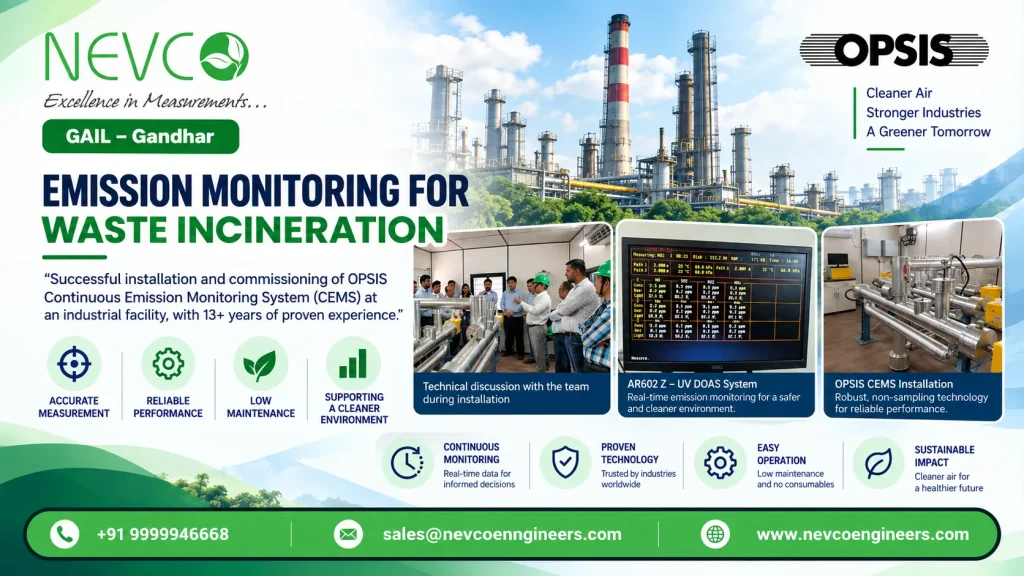
In a recent deployment, OPSIS delivered a complete CEMS setup at a waste incineration facility operated by GAIL Gandhar. The installation encompassed an advanced UV DOAS measurement unit, a purpose-built analyzer shelter, an optical measurement system, and an integrated gas monitoring backbone. The outcome was real-time emission visibility, improved operational decision-making, and streamlined compliance reporting, all while maintaining a low-maintenance profile suited to harsh industrial environments.
Key outcomes
- Real-time continuous emission data for multiple pollutants
- Robust optical measurement capable of handling dust and high temperatures
- Improved data visibility for operators and compliance teams
- Lower maintenance needs and simplified field servicing
- Enhanced support for environmental performance reporting
Building a reliable CEMS blueprint for waste incineration
To replicate these results, facilities should anchor their CEMS project on three pillars: rigorous site assessment, robust hardware, and seamless data integration. The following blueprint outlines practical steps:
- Define permit-relevant gases and measurement ranges with your regulator or utility.
- Choose an optical CEMS with UV DOAS that is rated for industrial environments and dust-prone ducts.
- Design an effective sample conditioning train: heated lines, condensate management, filtration, and desiccants as needed.
- Invest in rugged enclosures and protective housings to guard critical optics and electronics.
- Plan IT integration: link the CEMS to the DCS/SCADA, set alarms, dashboards, and automatic report generation.
- Execute thorough commissioning: verify performance against reference methods, establish QA/QC procedures, and train operators.
- Adopt a proactive maintenance program: scheduled optics cleaning, line replacements, and software updates.
Operational practices for sustained reliability
Beyond initial installation, ongoing care ensures long-term reliability:
- Regular calibration and drift checks per manufacturer guidance or regulatory requirements.
- Proactive sample-line maintenance to prevent contamination and blockage.
- Data quality monitoring: implement QA/QC flags and automated consistency checks.
- Remote diagnostics and timely spare parts to minimize downtime.
- Continuous improvement: review dashboards, adjust alarm thresholds, and optimize reporting templates.
Compliance, reporting, and environmental impact
Accurate, real-time data supports transparent reporting, accurate permit compliance, and evidence-based decision-making. By leveraging advanced optical CEMS, facilities can demonstrate cleaner production practices, reduce unplanned shutdowns due to regulation gaps, and contribute to local air-quality improvements.
Conclusion: Reliability that drives cleaner production
Investing in a purpose-built, application-focused emission monitoring solution for waste incineration delivers dependable performance in demanding environments. Real-time insights, reduced maintenance, and robust reporting empower operators to optimize process conditions while safeguarding the environment.