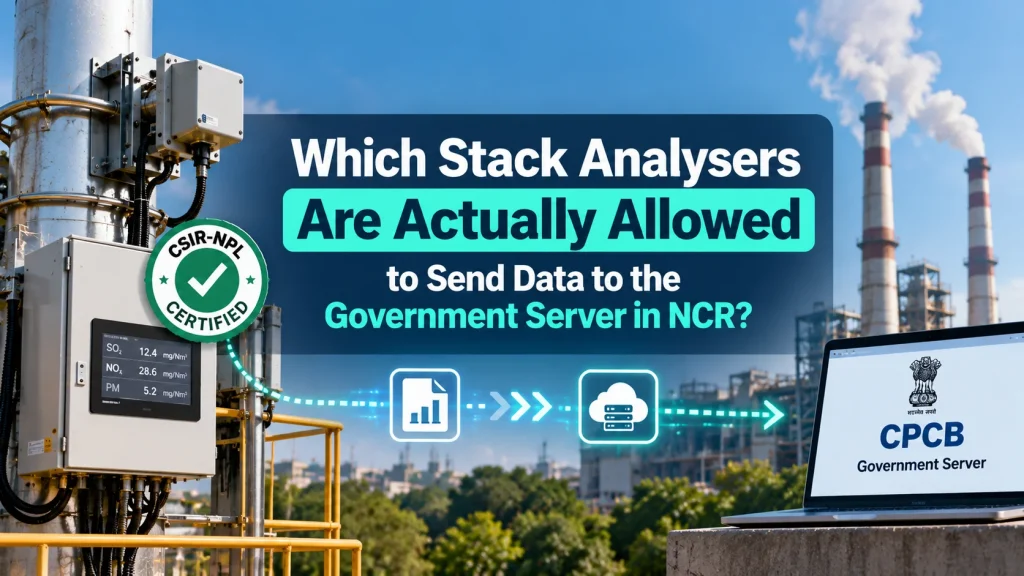
Quick answer: In NCR, only stack analysers certified by CSIR-NPL may send data to the CPCB server. CPCB made this mandatory for all air-polluting industries in NCR on 25 November 2025, when 21 OCEMS models were on the certified list. The list is updated from time to time, so check the exact model against CPCB’s current list before you buy.
Key takeaways
- CPCB’s notification of 25 November 2025 (No. CP-14/38/2025-AQMN-HO-CPCB-HO) allows only CSIR-NPL-certified OCEMS to connect to the CPCB server for air-polluting industries in NCR.
- CSIR-NPL had certified 21 OCEMS models when the rule was issued. CPCB publishes the list on its website and updates it periodically.
- A CPCB direction dated 12 January 2026 noted that NPL-certified OCEMS vendors were then available for PM, SO2 and NOx.
- An international certificate such as TÜV, MCERTS or USEPA does not replace CSIR-NPL verification for the CPCB portal.
- Before signing a purchase order, match the manufacturer, model, and parameter against the latest CPCB list, and ask for the certificate itself.
What did CPCB change for stack analysers in NCR, and when?
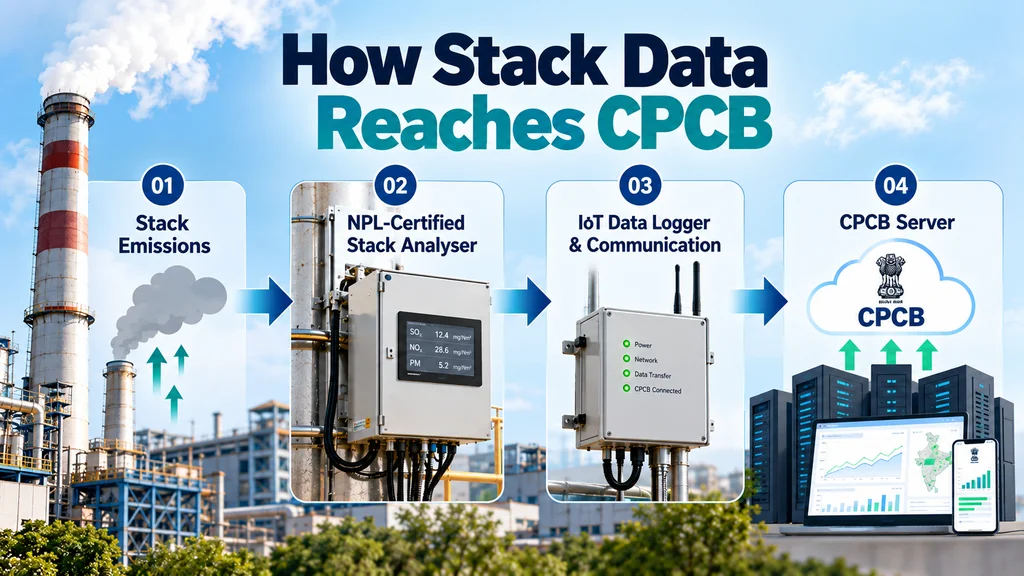
CPCB turned CSIR-NPL certification from a good practice into a condition for connecting to its server. If your analyser is not on the certified list, its data will not be accepted for CPCB connectivity in NCR.
The rule built up over several years:
- 22 August 2019: The government notified CSIR-NPL, India’s National Physical Laboratory, as the national certification agency for air quality monitoring instruments, including CEMS.
- CSIR-NPL’s scheme: CSIR-NPL developed the NPL India Certification Scheme (NPLI-CS) for CEMS, aligned with the European standard EN 15267 (Parts 1 to 3). Manufacturers submit two identical units for testing. Certificates are granted by the NPL India Certification Body, which includes members from CSIR-NPL, CPCB, and CSIR-NEERI.
- 30 August 2025: CPCB issued guidelines on accepting CEMS certification, listing the certificates the NPL India Certification Body issues: a Verification Certificate, a Product Conformity Certificate and a Provisional Letter of Confirmation for instruments still under product conformity testing.
- September 2025: CPCB told manufacturers to apply for CSIR-NPL certification by 15 September 2025, failing which their CEMS could be derecognised for CPCB’s OCEMS portal.
- 25 November 2025: CPCB mandated CSIR-NPL certified OCEMS for all air-polluting industries in NCR. Only certified models will be accepted for connectivity to the CPCB server, and SPCBs and PCCs in NCR must check the CPCB list regularly for updates.
The 25 November 2025 notification refers to earlier CPCB directions dated 1 October 2025 and 9 October 2025 on monitoring and connectivity in NCR. For background on what the certificate itself proves, see our post on the NPL certificate.
Does the certified analyser rule apply to your plant?
If your plant is an air-polluting industry in NCR that must run OCEMS, yes. The rule matters most if you are buying a new analyser, replacing an old one or connecting for the first time.
Check each line:
- Your unit is in Delhi, or in the NCR districts of Haryana, Uttar Pradesh or Rajasthan.
- Your unit falls in one of the 17 categories of high pollution potential industries.
- You run a common facility with a boiler or incinerator, such as a CETP with boilers, a biomedical or hazardous waste incinerator, or an MSW waste-to-energy plant.
- Your unit is a large or medium red category air-polluting industry.
- Your unit is in food and food processing, metal processing or textiles, where CPCB requires OCEMS and a PTZ camera.
- You have not yet installed OCEMS, or you plan to replace an existing analyser.
These categories come from CPCB’s direction dated 12 January 2026, which asked NCR boards to make OCEMS, and PTZ cameras where applicable, a condition of the Consent to Operate. The same direction said only OCEMS from NPL-certified vendors should be installed in units that have not yet installed OCEMS and in new units.
Outside NCR, the 25 November 2025 mandate does not apply as written. CPCB’s September 2025 notice to manufacturers, however, linked certification to recognition on the OCEMS portal, so plants elsewhere should check certification before any new purchase and follow their own state board’s directions.
What happens if your analyser is not certified?
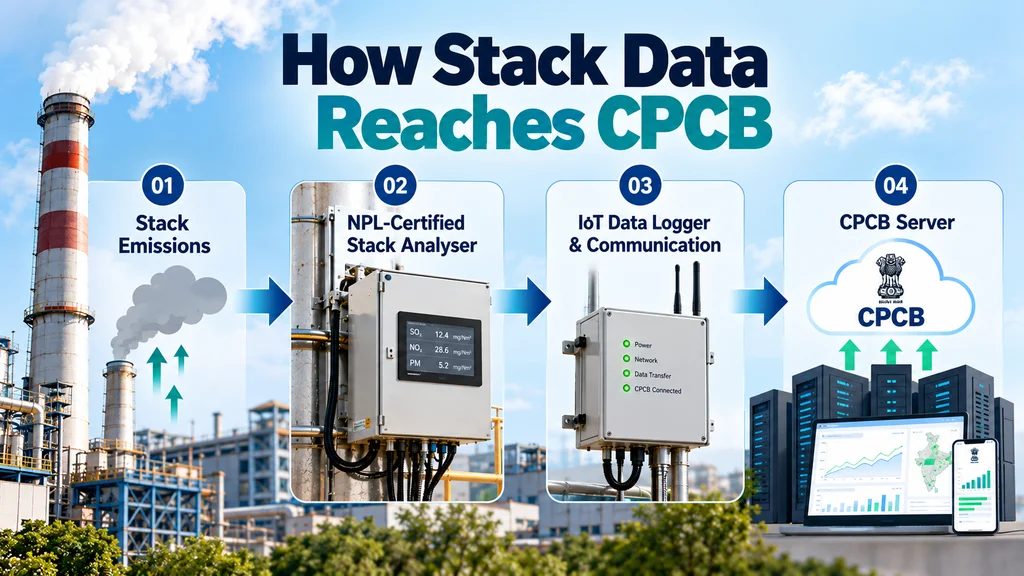
As per the 25 November 2025 notification, a non-certified model will not be accepted for connectivity to the CPCB server in NCR. In practice, that means your plant cannot show compliant online data, however well the analyser performs.
Once your data is not accepted, you are in the same position as a plant with missing data. That can lead to notices from your state board under its own procedures. CPCB’s 2026 directions in NCR have repeatedly tied OCEMS installation and connectivity to closure action against defaulting units. The certificate is what keeps an otherwise good instrument from becoming a compliance problem.
How do you check whether an analyser is CSIR-NPL certified?
Check the exact model against CPCB’s latest published list, then check the certificate itself. A brand name on a brochure is not enough.
- Get the exact model details. Ask the vendor for the manufacturer, full model name, variant and the parameters it will measure on your stack.
- Open CPCB’s current list. Download the latest list of CSIR-NPL certified OCEMS from the CPCB website and note its date. An older copy may be out of date.
- Match line by line. The manufacturer, model and parameter must all match. A certified SO2 analyser does not certify the same brand’s PM monitor.
- Ask for the certificate. Request a copy of the certificate from the NPL India Certification Body, and note whether it is a Verification Certificate, a Product Conformity Certificate or a Provisional Letter of Confirmation.
- Read the scope and validity. Check the measurement ranges, conditions and any expiry or renewal date written on the certificate.
- Confirm the supplied unit matches. On delivery, check the model on the nameplate against the certificate.
- File it. Keep the certificate and the dated CPCB list in your compliance file. Your state board may ask for both.
| Certificate from NPL India Certification Body | What it indicates | What to ask |
|---|---|---|
| Verification Certificate | The instrument has been verified by CSIR-NPL | Which parameters and ranges does it cover? |
| Product Conformity Certificate | The instrument has passed product conformity testing | Is the certificate current, and does it match this model? |
| Provisional Letter of Confirmation | The instrument is still under product conformity testing | Will your SPCB accept it for connection, and until when? |
Source: CPCB guidelines dated 30 August 2025 on acceptance of CEMS certification, as summarised by Lexplosion.
5 questions to ask any vendor before you buy
These five questions protect you from paying for an analyser that cannot connect. Ask them in writing and keep the replies.
- “Is this exact model on CPCB’s current certified list, for my parameters?” Ask the vendor to point to the entry in the latest list, not an old PDF.
- “Can I see the CSIR-NPL certificate, and what type is it?” A Provisional Letter of Confirmation is different from a full certificate. Know which one you are buying against.
- “Does the certificate cover my measurement range and stack conditions?” A cement kiln stack, a textile boiler, and a foundry cupola have very different temperature, moisture and dust loads.
- “Will your system send data directly to CPCB’s new portal, ODAMS, and who handles registration?” Certification gets you permission to connect. You still need a gateway that transmits directly to cems.cpcb.gov.in.
- “Who will service and calibrate it near my plant, and how fast?” A certified analyser that is down for three weeks waiting for a spare still leaves a gap in your data.
If a vendor hesitates on the first two questions, treat that as your answer.
What mistakes do buyers make with certified analysers?
Most mistakes happen at the purchase stage, when the price looks good, and the paperwork is assumed.
- Relying on a foreign certificate alone. CEMS certified by TÜV, MCERTS or USEPA still need CSIR-NPL verification for the CPCB system.
- Buying the right brand, wrong model. Certification is model-specific. A cheaper variant may not be on the list.
- Assuming one certificate covers every parameter. Check each parameter separately, especially if your consent asks for parameters beyond PM, SO2, and NOx.
- Not rechecking the list. CPCB updates the list periodically. Check again just before you sign the purchase order.
- Forgetting the connection side. A certified analyser with a gateway that cannot send data to ODAMS still leaves your station silent.
A situation we see often. A plant buys an analyser at a good price from a supplier who shows an international test report. At the connectivity stage, the model is not on CPCB’s certified list for NCR. The plant now has to buy a second analyser, and its deadline has not moved. A ten-minute check against the CPCB list at the quotation stage would have avoided both costs.
How Nevco helps you buy an analyser that can connect
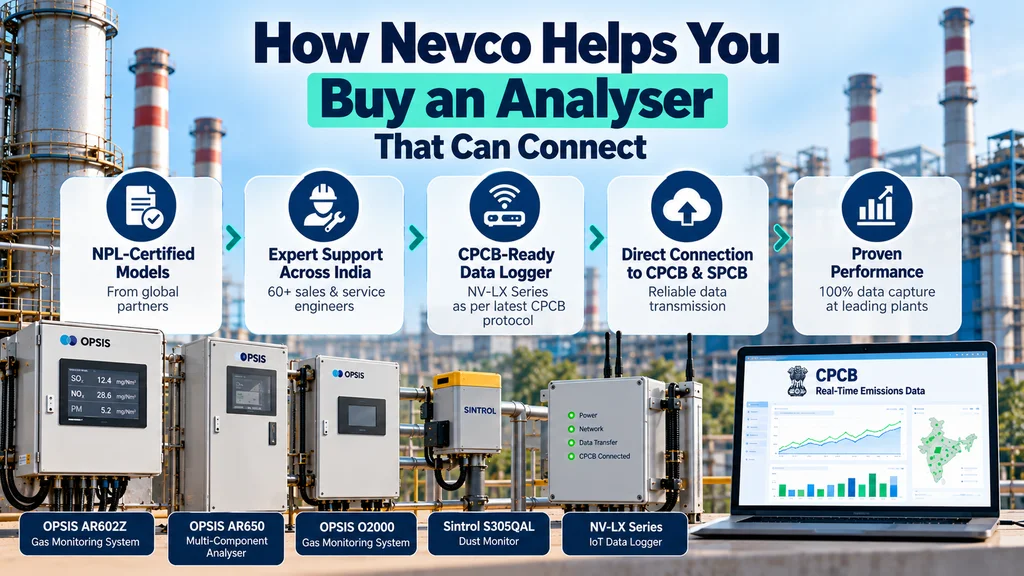
We help you choose an analyser for your stack, check it against CPCB’s current certified list and get it transmitting. Nevco has supplied stack monitoring instruments since 1982, with 10,000+ flue gas analyzers in our installed base.
- NPL-certified models from our global partners: our NPL certificates page lists the OPSIS AR602Z gas monitoring system, the OPSIS AR650 multi-component analyser, the OPSIS O2000, and the Sintrol S305QAL from the Sintrol S300 series of dust monitors. Ask us which parameters each certificate covers for your stack.
- 60+ sales and service engineers across India, trained at the principal manufacturers, with full calibration facilities.
- Connection to the regulator: our NV-LX Series IoT data logger is developed to the latest CPCB communication protocol and transmits data to CPCB and SPCB servers.
- Data capture results: IFFCO Kandla runs NH3 monitoring with 100% data capture, and Nubiola achieves 100% data capture to CPCB and SPCB.
See Nevco’s NPL-certified analysers.
Call: +91-9999946668
Email: sales@nevcoengineers.com
Monday to Saturday: 10:00 AM to 6:00 PM.
Which Stack Analysers Are Actually Allowed to Send Data to the Government Server in NCR?
Which stack analysers can send data to the CPCB server in NCR?
Only OCEMS models certified by CSIR-NPL. CPCB’s notification dated 25 November 2025 made this mandatory for all air-polluting industries in NCR and said only certified models will be accepted for connectivity to the CPCB server. CPCB publishes the certified list on its website and updates it periodically, so always check the latest version before buying.
How many OCEMS models are CSIR-NPL certified?
When CPCB issued its 25 November 2025 notification, CSIR-NPL had certified 21 OCEMS models for various parameters. CPCB has said the list will be updated from time to time as more models complete certification. Check the current list on the CPCB website for the latest count and for the parameters each model covers.
Is a TÜV, MCERTS or USEPA certificate enough in India?
No. CEMS already certified by TÜV, MCERTS or USEPA still need verification by CSIR-NPL to be accepted for the CPCB system. The CSIR-NPL scheme is aligned with the European standard EN 15267, so internationally certified instruments have a known testing basis, but Indian certification is still required for connecting in NCR.
Does the certified analyser rule apply outside NCR?
The 25 November 2025 mandate is written for air-polluting industries in NCR. Outside NCR, follow your state pollution control board’s directions. CPCB’s September 2025 notice told manufacturers that CEMS without a CSIR-NPL certification application could be derecognised for its OCEMS portal, so plants elsewhere should check certification status before any new purchase.
How do I check if an analyser is CSIR-NPL certified?
Download the latest list of certified OCEMS from the CPCB website and match the manufacturer, model, and parameter exactly. Then ask the vendor for a copy of the certificate from the NPL India Certification Body, and check its type, scope, measurement range, and validity. Keep both the certificate and the dated CPCB list in your compliance file.
Which parameters have certified analysers available?
As per CPCB’s direction dated 12 January 2026, OCEMS from NPL-certified vendors were then available for PM, SO2, and NOx. Certification for more parameters may have been added since then, as CPCB updates its list periodically. If your consent requires other parameters, check the current list and ask your state board how to proceed.