
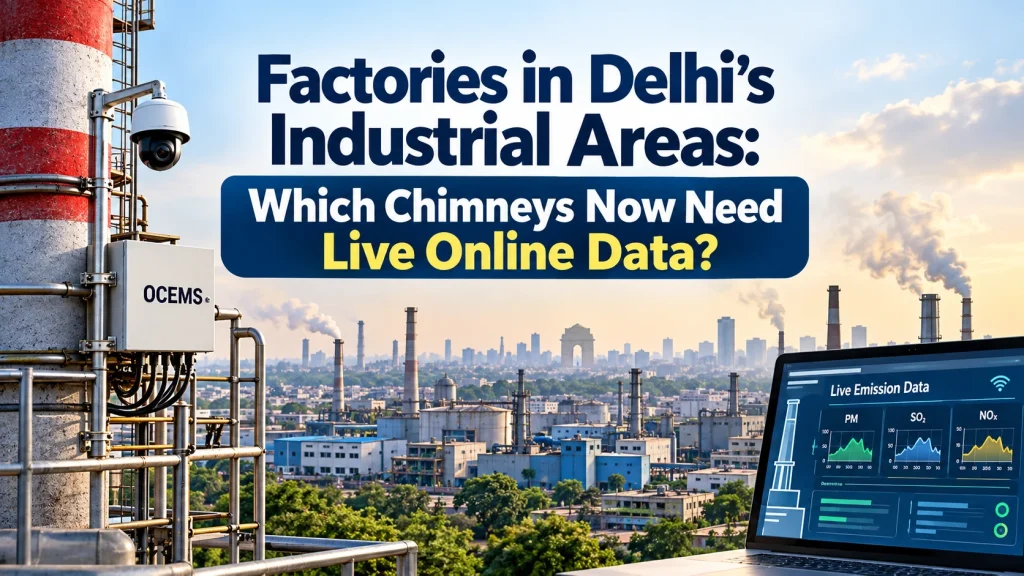
Quick answer: In Delhi, a chimney needs live online emission data if the unit falls in a category named in CPCB’s direction dated 12 January 2026: the 17 highly polluting categories, common facilities and incinerators, medium and large red category units, and food, metal and textile units. Food, metal, and textile units also need a PTZ camera. Your category decides this, not your industrial area.
Key takeaways
- CPCB’s direction dated 12 January 2026 (CP-11/16/2025/IPC-VI-HO-CPCB-HO), issued under Section 18(1)(b) of the Air Act, asks the boards of NCR-Delhi to make OCEMS a Consent to Operate condition for listed sectors.
- Food and food processing, metal processing, and textile units need both OCEMS and a PTZ camera. Earlier CPCB directions had set 31 December 2025 for these three sectors to install and connect.
- Only OCEMS from NPL-certified vendors may be installed. When the direction was issued, certification was available for PM, SO2, and NOx.
- The direction does not name any industrial area. A unit in Bawana, Narela, Okhla or Wazirpur is covered only if its category is covered.
- CPCB’s January 2026 list of units not registered on its new portal included Delhi units in Bawana and Patparganj.
What did CPCB direct for Delhi in January 2026?
CPCB told the pollution control boards of NCR-Delhi, including the Delhi Pollution Control Committee (DPCC), to write OCEMS and PTZ camera requirements straight into the Consent to Operate of listed units. That turns online monitoring from a separate order into a condition of your licence to run.
The direction is dated 12 January 2026 and carries reference CP-11/16/2025/IPC-VI-HO-CPCB-HO. It was issued by CPCB under Section 18(1)(b) of the Air (Prevention and Control of Pollution) Act, 1981, to the boards of Delhi, Haryana, Rajasthan, and Uttar Pradesh, with a copy to DPCC for follow-up. It gives three directions:
- Immediately add the OCEMS and PTZ camera condition to the consent of existing and upcoming units in the listed sectors.
- Require OCEMS and PTZ cameras where listed, for the specified emission parameters.
- Allow only OCEMS from NPL-certified vendors, currently available for PM, SO2 and NOx.
Each board had to acknowledge the direction and send CPCB an action taken report within 15 days.
The direction builds on a long trail. CPCB first directed red category air-polluting units in NCR and Delhi to install online monitoring on 29 December 2017. On 1 October 2025, it pushed boards to get the remaining NCR-Delhi units connected, and on 9 October 2025, it set 31 December 2025 for food, metal, and textile units to install OCEMS and PTZ cameras and connect to CPCB and board servers. CPCB gave its reason plainly: poor air quality in NCR-Delhi and the need for industries to monitor themselves under the polluter pays principle.
Which categories of Delhi units need online monitoring?
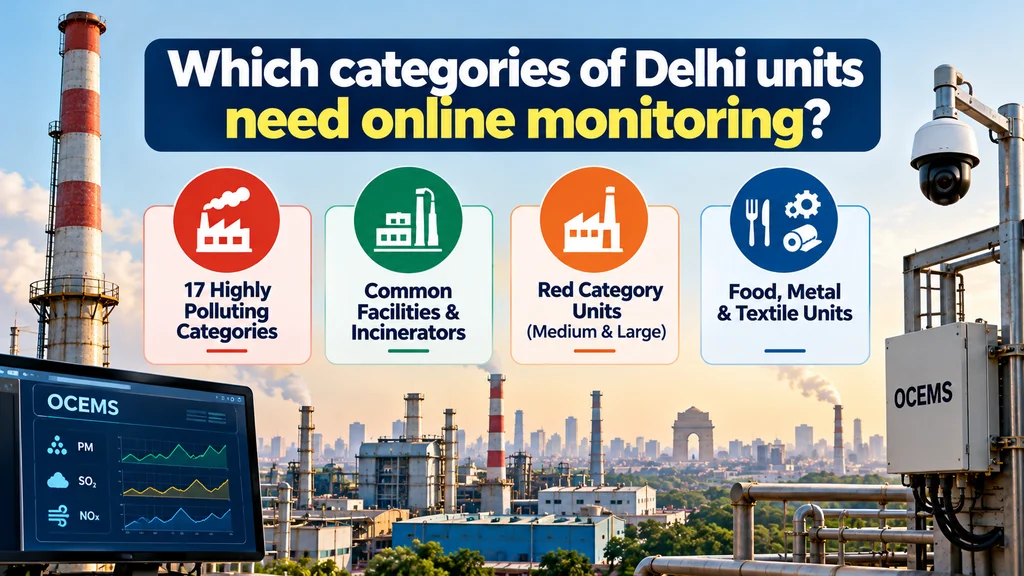
Four groups are covered. If your unit sits in any of them, your chimney needs live data, wherever in Delhi it is.
| Group | Examples | OCEMS | PTZ camera |
|---|---|---|---|
| 17 categories of highly polluting industries | As identified by CPCB | Yes | Not listed |
| Common facilities and incinerators | CETPs with boilers, biomedical waste and hazardous waste incinerators, MSW incineration-based waste-to-energy plants | Yes | Not listed |
| Red category air-polluting units, medium and large | Other than the three sectors below | Yes | Not listed |
| Food and food processing, metal processing, textile | Boilers, furnaces, thermic fluid heaters in these units | Yes | Yes |
Source: CPCB direction dated 12 January 2026, sector table.
Use this quick check with your EHS manager:
- Is your unit red category, and medium or large scale?
- Is it in one of CPCB’s 17 highly polluting categories?
- Do you run a CETP, incinerator, or waste-to-energy plant?
- Is it a food, metal, or textile unit with a boiler, furnace, or heater stack?
One yes means OCEMS applies. A yes to the last line means a PTZ camera too.
Which Delhi industrial areas does this affect?
Every industrial area in Delhi is affected, because the direction works by category, not by location. We checked the 12 January 2026 direction for named areas such as Bawana, Narela, Okhla and Wazirpur: it names none of them, and it carries no list of units.
What matters is the mix of units in each area. Delhi has 29 planned industrial areas and estates, as per the Delhi Government’s economic survey. The table lists major Delhi estates, with the public source that identifies each one as an industrial area.
| Industrial area | Identified by | What to check |
|---|---|---|
| Bawana | DSIIDC relocation estate. Two Bawana units were on CPCB’s January 2026 list of units not registered on its new portal | Category, then ODAMS registration and live data |
| Narela | DSIIDC relocation estate | Category. Food, metal and textile stacks need PTZ cameras |
| Okhla | DSIIDC relocation estate | Category, and whether your consent already carries the OCEMS condition |
| Patparganj | DSIIDC relocation estate. One Patparganj unit was on CPCB’s January 2026 unregistered list | Category, then ODAMS registration |
| Badli | DSIIDC relocation estate, also listed for redevelopment | Category |
| Jhilmil | DSIIDC relocation estate, also listed for redevelopment | Category |
| Wazirpur | Listed by the Delhi Government for road and drain redevelopment | Metal processing units need OCEMS and a PTZ camera |
| Mayapuri Phase-II, Kirti Nagar, Udyog Nagar, Mangolpuri Phase-I, Moti Nagar, Lawrence Road, G.T. Karnal | Listed by the Delhi Government for redevelopment | Category |
Two practical points follow. First, being a small unit in a busy estate does not exempt you if you are in a listed category, such as metal processing. Second, the reverse also holds: a unit in Bawana or Okhla outside every listed category is not covered by this direction, though your own consent may still ask for monitoring.
What about Delhi units that run on PNG or electricity?

Many Delhi units have already moved boilers to piped natural gas or electricity. CPCB clarified on 20 April 2026 that such boilers and thermic equipment in Delhi-NCR do not need air pollution control devices, provided the unit gets board certification of exclusive PNG or electricity use and uploads it to the CPCB APCD portal.
That clarification is about pollution control devices. It does not mention OCEMS. If your unit is in a listed category and runs on PNG, ask DPCC in writing how the OCEMS condition in your consent applies to your stack, and keep the reply on file.
How do you comply if your Delhi unit is covered?
Start with your consent, then get certified equipment connected to CPCB’s new portal.
- Read your Consent to Operate. Check whether DPCC has added the OCEMS and PTZ camera condition, and which parameters it lists.
- Choose a certified analyser. Only NPL-certified OCEMS may be installed. Our post on which stack analysers can connect in NCR explains how to check a model.
- Install at the right point. The sampling location must follow CPCB guidance, with safe access for calibration.
- Fit the PTZ camera if you are a food, metal or textile unit, with a clear view of the stack.
- Register and connect to ODAMS. Register at cems.cpcb.gov.in and send data directly to CPCB. If you were only on the old portal, read why old portal registration is not enough.
- Verify live data. Check the portal for 48 to 72 hours and save screenshots.
- Keep records. File the certificate, calibration records and your registration with your consent papers.
Also keep your PM limit in view. CAQM Direction No. 98 sets 50 mg/Nm³ for listed NCR industries, with 1 October 2026 as the common compliance date, and your online data will show whether you meet it.
What mistakes do Delhi units make?
- Thinking the estate decides coverage. No industrial area is named in the direction. Your category decides.
- Buying an uncertified analyser. A cheaper non-NPL model cannot be used under this direction.
- Forgetting the camera. Food, metal, and textile units need a PTZ camera as well as OCEMS.
- Assuming PNG means no monitoring. The April 2026 clarification covers APCDs only.
- Stopping at installation. Data must reach CPCB’s new portal, live and continuous.
A situation we see often. A small metal processing unit in a Delhi estate assumes the rules are only for big factories nearby. Its new consent renewal arrives with the OCEMS and PTZ camera condition already written in. The unit then has to source certified equipment, a camera and portal registration together, at short notice. Checking the category early would have spread that work out.
How Nevco helps Delhi units
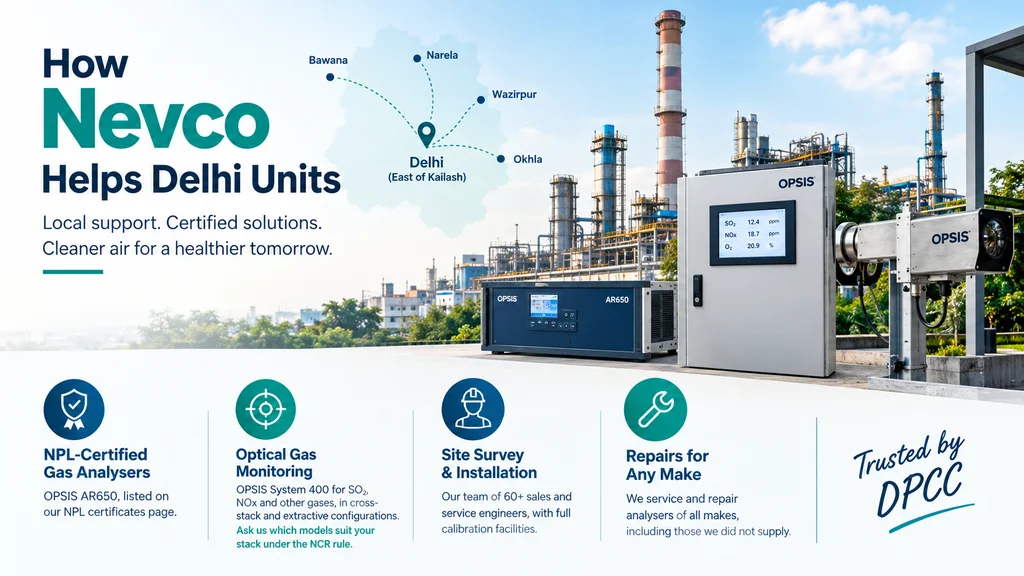
Our head office is in East of Kailash, Delhi, so our engineers can reach Bawana, Narela, Okhla, Wazirpur and the rest of Delhi’s industrial areas quickly. Nevco has worked in emission monitoring since 1982, and DPCC is among our clients.
- NPL-certified gas analysers such as the OPSIS AR650, listed on our NPL certificates page.
- Optical gas monitoring with the OPSIS System 400 for SO2, NOx and other gases, in cross-stack and extractive configurations. Ask us which models suit your stack under the NCR certification rule.
- Site survey and installation by our team of 60+ sales and service engineers, with full calibration facilities.
- Repairs for any make, including analysers Nevco did not supply.
Delhi-based team, quick site visit. Call +91-9999946668 or email sales@nevcoengineers.com, Monday to Saturday, 10:00 AM to 6:00 PM. Our office: 90 A, 2nd Floor, Opposite Iskon Temple, Amritpuri, B Main Road, East of Kailash, Delhi 110065.
FAQs
Which factories in Delhi need online emission monitoring?
As per CPCB’s direction dated 12 January 2026, units in Delhi need OCEMS if they are in CPCB’s 17 highly polluting categories, run common facilities or incinerators, are medium or large red category air-polluting units, or are food processing, metal processing, or textile units. The last three sectors also need a PTZ camera on the stack.
Does the CPCB direction name industrial areas like Bawana or Okhla?
No. The 12 January 2026 direction does not name any industrial area and has no list of units. It applies by category across NCR-Delhi. A unit in Bawana, Narela, Okhla, Wazirpur or any other estate is covered if its category is listed, and not covered by this direction if it is not.
Which Delhi units need a PTZ camera?
Food and food processing, metal processing and textile units need a PTZ camera in addition to OCEMS, as per CPCB’s direction dated 12 January 2026. An earlier CPCB direction dated 9 October 2025 had set 31 December 2025 for these units to install OCEMS and PTZ cameras and connect them to CPCB and board servers.
Can I install any analyser to meet the Delhi requirement?
Can I install any analyser to meet the Delhi requirement?
No. The direction allows only OCEMS from NPL-certified vendors, and certification was available for PM, SO2, and NOx when it was issued. CPCB’s notification of 25 November 2025 also says only CSIR-NPL certified models can connect to its server in NCR. Check the exact model against CPCB’s current certified list before buying.
Do PNG-fired boilers in Delhi need OCEMS?
CPCB’s 20 April 2026 clarification says PNG or electric boilers in Delhi-NCR do not need air pollution control devices, with board certification of exclusive clean fuel use. It does not address OCEMS. If your unit is in a listed category, confirm with DPCC how the OCEMS condition in your consent applies to a PNG stack.