

Quick answer: For most industrial boilers in India, the national limit is for particulate matter (PM): 500 mg/Nm³ below 2 t/h, 150 mg/Nm³ (or 250 for agro fuels) from 2 to under 10 t/h, and 100 mg/Nm³ (or 250 for agro fuels) at 10 t/h and above, corrected to 6% O2 for solid fuel and 3% for liquid fuel. In Delhi-NCR, CAQM has set 50 mg/Nm³ for listed industries.
Key takeaways
- National boiler limits come from the Environment (Protection) Amendment Rules, 2023, notified on 16 May 2023, which replaced the “Boilers” entry at serial no. 70 of Schedule I. They took effect two years after publication, in May 2025.
- These national limits are for PM, set by steam generation capacity and fuel. They cover boilers, thermic fluid heaters and hot air generators in all industries other than the power sector.
- Every reading must be corrected to the reference oxygen level, on a dry basis: 6% O2 for solid fuels and 3% O2 for liquid fuels.
- In Delhi-NCR, CAQM Direction No. 98 dated 20 February 2026 sets a PM limit of 50 mg/Nm³ for listed industries, applicable from 1 October 2026.
- Your Consent to Operate can set a stricter limit than the national standard. Where it does, the consent limit is the one you must meet.
Which rule sets the emission limit for your boiler?
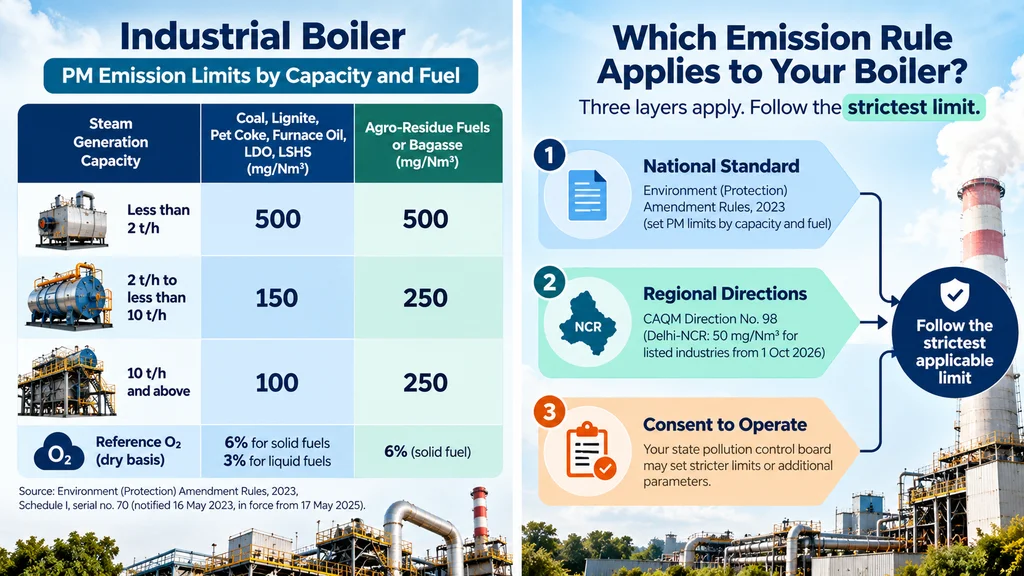
The answer depends on where your plant is and what your boiler does. Three layers apply, and the strictest one that covers you is your working limit.
- The national standard. The Environment (Protection) Amendment Rules, 2023, notified by the Ministry of Environment, Forest and Climate Change on 16 May 2023, set PM limits for industrial boilers. The draft of these rules was published as G.S.R. 477(E) on 27 June 2022.
- Regional directions. In Delhi-NCR, the Commission for Air Quality Management (CAQM) sets tighter limits through statutory directions.
- Your consent. Your state pollution control board can write a stricter limit, or extra parameters, into your Consent to Operate.
The 2023 rules apply to “all industries (other than power sector)”. They cover boilers fired on coal or lignite, pet coke, bagasse or agro fuels, furnace oil, light diesel oil and low sulphur heavy stock. Thermic fluid heaters and hot air generators are covered on an equivalent fuel consumption basis.
Boilers at coal or lignite power plants follow the thermal power plant standards notified as S.O. 3305(E) on 7 December 2015, as amended. Those standards are outside the table below.
What are the PM limits for industrial boilers by size and fuel?
The national PM limit falls as the boiler gets bigger, and boilers on agro fuels or bagasse get a higher limit above 2 t/h. All values are in mg/Nm³, on a dry basis, at the reference oxygen level.
| Steam generation capacity | Coal, lignite, pet coke, furnace oil, LDO, LSHS (mg/Nm³) | Agro-residue fuels or bagasse (mg/Nm³) |
|---|---|---|
| Less than 2 t/h | 500 | 500 |
| 2 t/h to less than 10 t/h | 150 | 250 |
| 10 t/h and above | 100 | 250 |
| Reference O2, dry basis | 6% for solid fuels, 3% for liquid fuels | 6% (solid fuel) |
Source: Environment (Protection) Amendment Rules, 2023, Schedule I, serial no. 70, notified 16 May 2023, in force from 17 May 2025.
Download this table as a spreadsheet (CSV)
Two points from the rule-making are worth knowing. The 2022 draft had proposed 50 mg/Nm³ for boilers of 10 t/h and above on conventional fuels, but the final rules set 100. The draft also proposed continuous emission monitoring for boilers of 10 t/h and above, which was dropped in the final rules. Your consent or a CPCB direction can still require online monitoring, as explained in our post on CPCB guidelines for OCEMS.
What limit applies to boilers in Delhi-NCR?
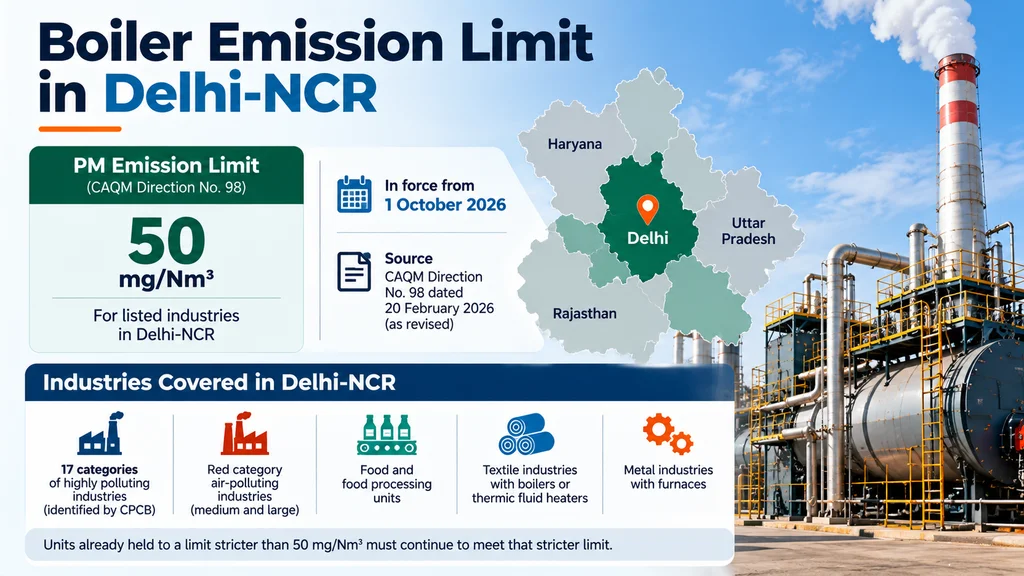
In Delhi-NCR, CAQM Direction No. 98, dated 20 February 2026, sets a maximum PM emission limit of 50 mg/Nm³ for listed industries. CAQM later revised its implementation date to 1 October 2026, so it now applies.
Direction No. 98 covers these industries in Delhi-NCR:
- The 17 categories of highly polluting industries identified by CPCB
- Red category air-polluting industries (medium and large)
- Food and food processing units
- Textile industries with boilers or thermic fluid heaters
- Metal industries with furnaces
Units already held to a limit stricter than 50 mg/Nm³ must keep meeting that stricter limit. Before this direction, CAQM’s March 2022 direction had set 80 mg/Nm³ for boilers on biomass and other fuels in NCR.
| Region | Boilers covered | PM limit (mg/Nm³) | In force from | Source |
|---|---|---|---|---|
| All India (except power sector) | By capacity and fuel | 100 to 500 (see table above) | 17 May 2025 | E(P) Amendment Rules, 2023 |
| Delhi-NCR | Industries listed in Direction No. 98 | 50 | 1 October 2026 | CAQM Direction No. 98 dated 20.02.2026, as revised |
CAQM originally set 1 August 2026 for medium and large industries and 1 October 2026 for the rest. In August 2026, it made 1 October 2026 the common compliance date for all covered industries. Some industry bodies have sought more time, up to 31 March 2027, but no further extension had been reported at the time of writing.
What about SO2 and NOx limits for boilers?
For industrial boilers outside the power sector, the 2023 national table sets numeric limits for PM. SO2 is addressed through a minimum stack height and through the fuel you burn. The notification still asks for PM, SO2, and NOx readings to be normalised to the reference oxygen level, so measure all three the same way.
The stack height rule takes the greater of two formulas:
- H = 14 Q^0.3, where Q is SO2 emission in kg/h
- H = 74 Q^0.27, where Q is PM emission in tonne/h
A minimum stack height also applies, and it is higher for larger boilers. Your consent will state the height approved for your stack.
Where numeric SO2 or NOx limits do apply to your boiler, they come from one of three places:
- Your Consent to Operate. Many state boards write SO2 and NOx limits into the consent, especially for coal and pet coke boilers.
- Industry-specific standards in Schedule I of the Environment (Protection) Rules, 1986, where your sector has its own entry.
- Thermal power plant standards under S.O. 3305(E), for power sector boilers.
Read your consent first. If it lists SO2 or NOx limits, those are binding on your stack.
How do you correct a stack reading to the reference oxygen level?
Correct every reading to the reference oxygen level before comparing it with the limit. A raw reading taken at high excess air looks lower than it really is.
Use this formula on a dry basis:
Corrected value = Measured value × (21 − O2 reference) ÷ (21 − O2 measured)
Worked example. A 6 t/h coal-fired boiler shows PM of 120 mg/Nm³, with 10% O2 in the flue gas. The reference for solid fuel is 6% O2.
Corrected PM = 120 × (21 − 6) ÷ (21 − 10) = 120 × 15 ÷ 11 = about 164 mg/Nm³
The raw figure of 120 looks safe against the 150 limit. The corrected figure of about 164 is over it. This is why you need a reliable O2 reading alongside every PM, SO2 or NOx measurement. A portable flue gas analyser such as the KANE 988 or an in-situ zirconia oxygen analyser such as the OXY600 gives you that O2 figure.
What mistakes do plants make when checking boiler limits?
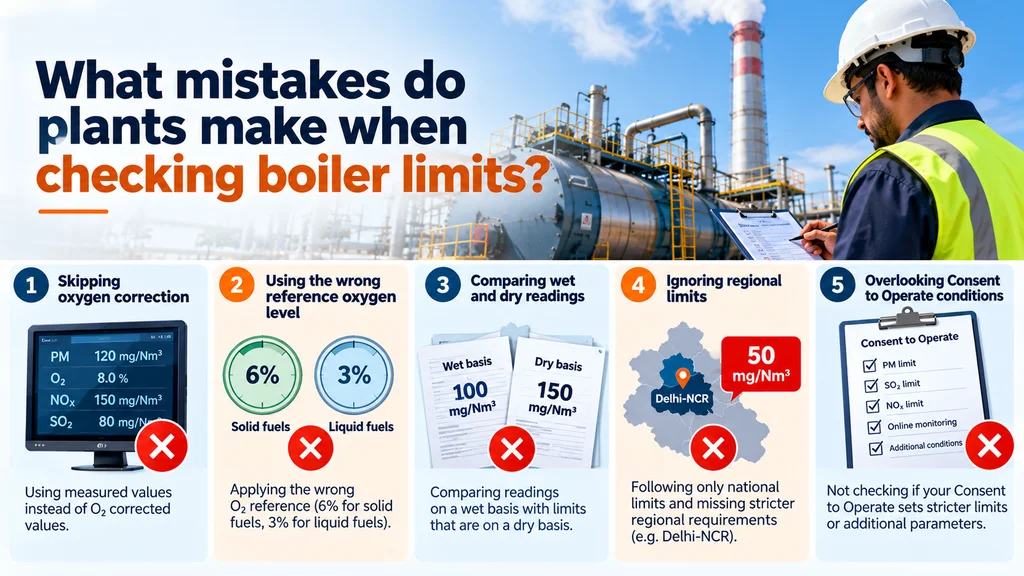
Most errors come from comparing the wrong number with the wrong limit.
- Skipping O2 correction. As the worked example shows, an uncorrected reading can hide an exceedance.
- Using the wrong reference. Solid fuels use 6% O2 and liquid fuels use 3%. A boiler that switches from coal to furnace oil changes its reference.
- Reading wet instead of dry. The limits are on a dry basis. Moisture in the sample dilutes the reading.
- Following the national table in NCR. A 12 t/h coal boiler meeting 100 mg/Nm³ may still breach the 50 mg/Nm³ CAQM limit if the unit is in a listed category.
- Ignoring the consent. A consent limit stricter than the national table overrides it for your plant.
- Counting a thermic fluid heater as exempt. The 2023 rules cover thermic fluid heaters and hot air generators on an equivalent fuel consumption basis.
A situation we see often. A plant’s outside monitoring report shows the boiler well within its limit. When our engineer checks with a portable analyser, the stack O2 is around 12% because of air leaking in at the duct. Once corrected to 6% O2, the PM figure is far closer to the limit than the report suggested. The fix starts with sealing the leak, then retesting.
How Nevco helps you check your boiler against these limits
We measure your stack and give you corrected numbers you can compare with your limit. Nevco has supplied combustion and emission monitoring instruments since 1982, when we started as Combustion Analysers, and our installed base includes 10,000+ flue gas analyzers.
- Portable flue gas analysers such as the KANE 988, which measures up to eight gases including O2, CO, CO2, NO, NO2 and SO2, for spot checks across your boilers.
- Continuous oxygen measurement with the OXY600, an in-situ zirconia analyser for boilers, furnaces and stacks.
- Continuous PM monitoring for boilers that must report online, through our stack dust monitoring range, including Sintrol systems.
- 60+ sales and service engineers across India, with full calibration facilities, and repairs even for instruments not supplied by Nevco.
We are ISO 9001:2015 certified and won the CII National Energy Efficiency competition as an Energy Efficient Technology Provider.
Check your boiler against these limits with a portable analyser. Call +91-9999946668 or email sales@nevcoengineers.com, Monday to Saturday, 10:00 AM to 6:00 PM.
FAQs
What is the PM emission limit for an industrial boiler in India?
Under the Environment (Protection) Amendment Rules, 2023, the PM limit is 500 mg/Nm³ for boilers below 2 t/h. For 2 to under 10 t/h, it is 150 mg/Nm³ on conventional fuels and 250 on agro fuels. For 10 t/h and above, it is 100 and 250 mg/Nm³. Your consent or a regional direction may set a stricter limit.
What reference oxygen level applies to boiler emission limits?
The 2023 boiler standards are normalised on a dry basis to 6% O2 for solid fuels such as coal, pet coke and biomass, and 3% O2 for liquid fuels such as furnace oil and LDO. Correct every reading with the formula: corrected value equals measured value multiplied by (21 minus reference O2) divided by (21 minus measured O2).
What is the boiler PM limit in Delhi-NCR?
CAQM Direction No. 98, dated 20 February 2026, sets a maximum PM limit of 50 mg/Nm³ for listed industries in Delhi-NCR. These include the 17 highly polluting categories, medium and large red category air-polluting units, food processing, textile units with boilers or thermic fluid heaters, and metal units with furnaces. The revised start date is 1 October 2026.
Are there SO2 and NOx limits for industrial boilers?
The 2023 national boiler rules set PM limits only. SO2 is managed through a minimum stack height formula and the fuel used. Numeric SO2 and NOx limits for your boiler, if any, will usually be in your Consent to Operate or your industry’s own entry in Schedule I. Power sector boilers follow separate thermal power plant standards.
Do these limits apply to thermic fluid heaters?
Yes. The Environment (Protection) Amendment Rules, 2023 cover thermic fluid heaters and hot air generators on an equivalent fuel consumption basis, alongside steam boilers. In Delhi-NCR, CAQM Direction No. 98 also names textile industries with boilers or thermic fluid heaters among the units that must meet the 50 mg/Nm³ PM limit.
When did the new boiler emission standards come into force?
The Environment (Protection) Amendment Rules, 2023 were notified on 16 May 2023 and came into force two years after publication in the Official Gazette, in May 2025. Industries had that two-year window to upgrade their air pollution control devices to meet the new limits.