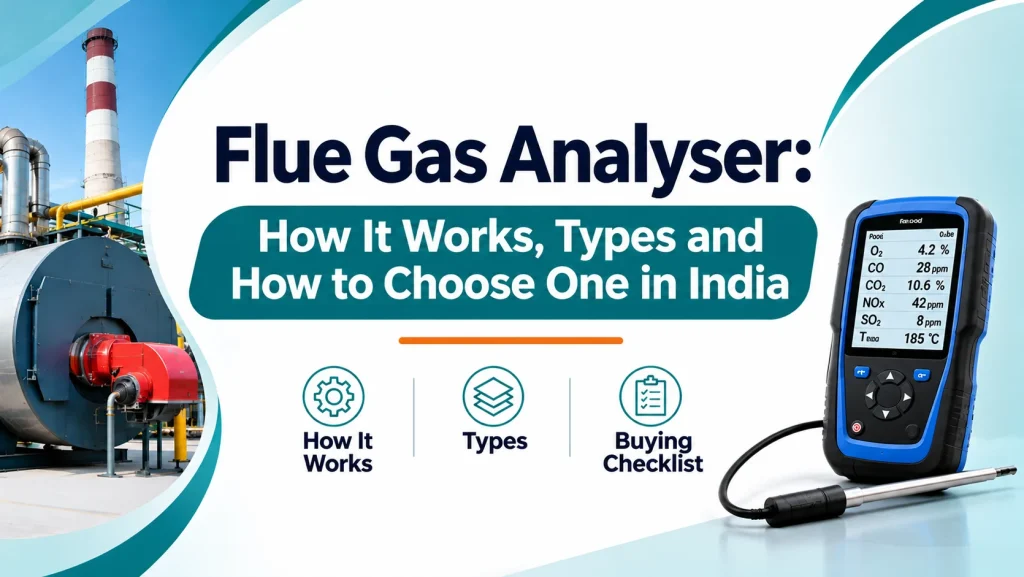
Quick answer: A flue gas analyser is an instrument that draws a sample from a boiler, furnace or burner exhaust and measures gases such as O₂, CO, CO₂, NOx and SO₂, along with flue gas temperature. From those readings it calculates excess air and combustion efficiency, so you can tune the burner, cut fuel waste and check emissions. Portable units suit testing and servicing. Fixed online systems suit continuous compliance.
Key takeaways
- Most portable flue gas analysers use electrochemical cells for O₂, CO, NO, NO₂ and SO₂. Infrared (NDIR) is common for CO₂ and hydrocarbons. FTIR is used in fixed systems that need many gases at once.
- O₂ and CO together tell you whether the burner has too much air (wasted heat) or too little (wasted fuel and CO).
- Buy for the gases your fuel and consent actually need, not the longest sensor list.
- A portable analyser is a tuning and checking tool. It does not replace an online CEMS where your consent requires one.
- Sensor life, calibration support and service in India matter as much as the purchase price.
What is a flue gas analyser (flue gas analyzer)?
A flue gas analyser, also spelt flue gas analyzer, measures the gases leaving a combustion process so you can see how well the fuel is burning. Both spellings mean the same instrument. Indian and British English use “analyser”, while American brochures use “analyzer”.
You will also hear it called a combustion analyser, an exhaust gas analyser or a stack gas analyser. Boiler operators, energy auditors, burner service engineers and EHS teams use it to answer three questions:
- Is the air-to-fuel ratio right?
- How much heat is going up the chimney?
- Are CO, NOx and SO₂ where they should be?
How does a flue gas analyser work?
A pump pulls flue gas through a probe placed in the stack, the gas is cleaned and cooled, and then sensors measure each gas while a thermocouple reads the flue temperature. The instrument combines these readings with fuel data to calculate excess air, CO₂ (if not measured directly) and combustion efficiency.
The sample path in a typical portable unit looks like this:
- Probe and thermocouple inserted into the flue through a test point, usually after the last heat exchanger.
- Sample hose that carries gas back to the instrument.
- Water trap and particulate filter that remove condensate and dust, both of which damage sensors.
- Pump that draws a steady flow across the sensors.
- Sensor block that measures each gas.
- Processor and display that calculate results, store them and print or send a report.
A good reading depends on probe position. Put the tip near the centre of the flue, away from air leaks, and let the reading settle before you note it.
Which measurement methods do flue gas analysers use?
Three methods cover most instruments in India: electrochemical cells, non-dispersive infrared (NDIR) and Fourier transform infrared (FTIR). Each has a place.
| Point | Electrochemical | NDIR (non-dispersive infrared) | FTIR (Fourier transform infrared) |
|---|---|---|---|
| How it works | Gas diffuses into a cell and reacts at an electrode, producing a current proportional to concentration | Gas absorbs infrared light at a wavelength specific to that gas; less light reaching the detector means more gas | The instrument reads the full infrared spectrum and separates many gases from one measurement |
| Typical gases | O₂, CO, NO, NO₂, SO₂, H₂S | CO₂, CO, hydrocarbons | Many at once, including H₂O, HCl, HF, NH₃, CO and CO₂ |
| Where you find it | Portable and handheld analysers | Portable and fixed analysers | Fixed multi-gas systems and laboratories |
| Strengths | Compact, low power, low cost per gas | Stable, long sensor life, little drift | Wide gas range, handles wet and corrosive gas well |
| Watch-outs | Sensors age and need replacing; some respond to other gases; high CO can saturate the cell | One gas per optical channel; affected by water vapour if not compensated | Higher cost; needs a heated sample path and skilled set-up |
Two more methods appear for oxygen in fixed installations. Zirconia sensors sit directly in the flue and give a fast O₂ signal for burner trim, as in our OXY600 online oxygen analyser. Paramagnetic cells are used in some extractive systems. Optical methods such as DOAS, used in many CEMS, measure across the stack without drawing a sample at all.
Which gases does a flue gas analyzer measure, and why do they matter?
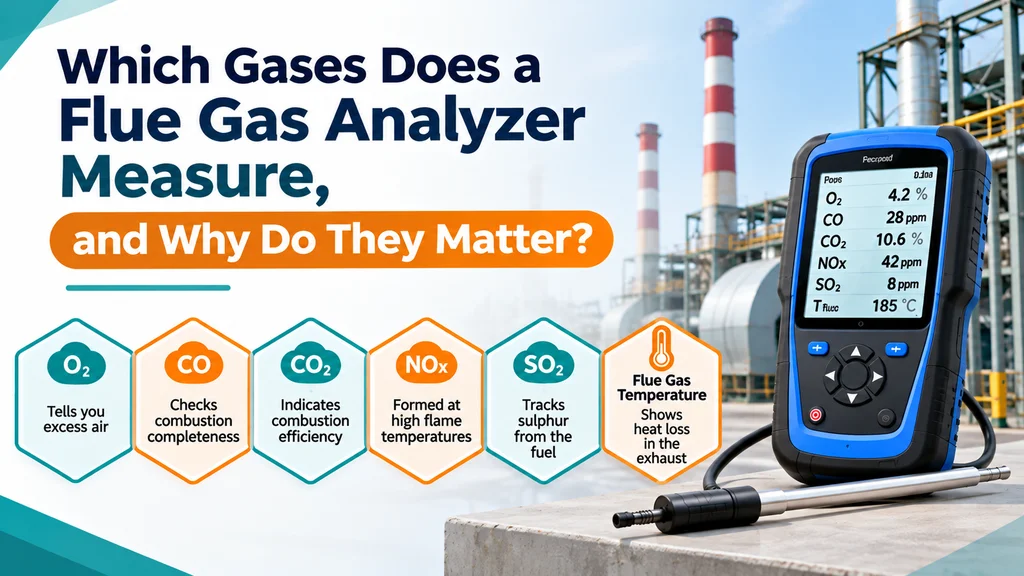
O₂ and CO are the two readings that drive burner tuning. CO₂, NOx and SO₂ add the emissions picture, and flue temperature gives you the heat loss.
| Reading | What it tells you | What to do when it is off |
|---|---|---|
| O₂ (oxygen) | How much excess air is going through the burner | High O₂ means too much air and heat lost up the stack. Close the air damper in small steps. |
| CO (carbon monoxide) | Whether combustion is complete | Rising CO means too little air, poor mixing or a dirty burner. Stop reducing air and check the burner. |
| CO₂ (carbon dioxide) | The other side of the O₂ reading; peaks at the correct ratio | Often calculated from O₂ for a known fuel. Measured directly on some models. |
| NO and NO₂ (NOx) | Nitrogen oxides formed at high flame temperature | High NOx points to very hot combustion or high excess air; relevant where your consent sets a NOx limit. |
| SO₂ (sulphur dioxide) | Sulphur coming from the fuel | Tracks fuel sulphur. Important for coal, furnace oil and petcoke users. |
| Flue gas temperature | Heat leaving with the exhaust | High temperature at normal load can mean fouled heat transfer surfaces or an air heater problem. |
| Draught | Pressure in the flue | Poor draught affects air supply and safety. |
The sweet spot is the lowest O₂ that still keeps CO low. Go below it and CO climbs fast. Stay far above it and you heat air for nothing. We work through the efficiency numbers in our boiler efficiency formula and calculation post.
Portable or fixed: which type of flue gas analyser do you need?
Choose a portable flue gas analyzer for testing, tuning and spot checks across many boilers. Choose a fixed online analyser or CEMS when you need continuous data, burner trim control or compliance reporting.
| Point | Portable flue gas analyser | Fixed online analyser or CEMS |
|---|---|---|
| Use | Burner tuning, servicing, energy audits, spot checks | Continuous monitoring, O₂ trim control, compliance |
| Readings | When a technician takes them | Every few seconds, around the clock |
| Data to the regulator | No | Yes, where connected to CPCB and the state board |
| Covers many boilers | Yes, one unit moves between sites | One system per stack or duct |
| Example from our range | KANE 458s, KANE 958, KANE 988 | Continuous emission monitoring systems, OXY600 |
Many plants own both. The online system watches the stack all day. The portable unit lets the boiler team tune burners, check a second boiler, and cross-check the fixed analyser after maintenance. If your consent requires online stack data, read our explainer on the OCEMS full form and what each system covers before you decide what to buy.
Nevco’s KANE flue gas analyser range
We supply the KANE range of portable flue gas analysers in India, with sales, service and calibration support. Here is how the three models compare.
| Point | KANE 458s | KANE 958 | KANE 988 |
|---|---|---|---|
| Best for | Routine boiler servicing and quick checks | Commercial and industrial combustion tuning | Advanced combustion analysis and emissions work |
| Gases measured | O₂ and CO, with CO₂ calculated | O₂, CO and CO₂, with optional NO, NO₂ and SO₂ | Up to 8 gases: O₂, CO, CO₂, HC, NO, NO₂, SO₂, H₂S |
| Also reads | Flue temperature, ambient temperature, draught, efficiency | Flue temperature, efficiency | Flue temperature, efficiency |
| Notable features | Wireless communication, upgradeable sensors, rotary dial | Fully upgradeable, CO sensor protection | Sensor protection, large colour display, reporting |
KANE 458s
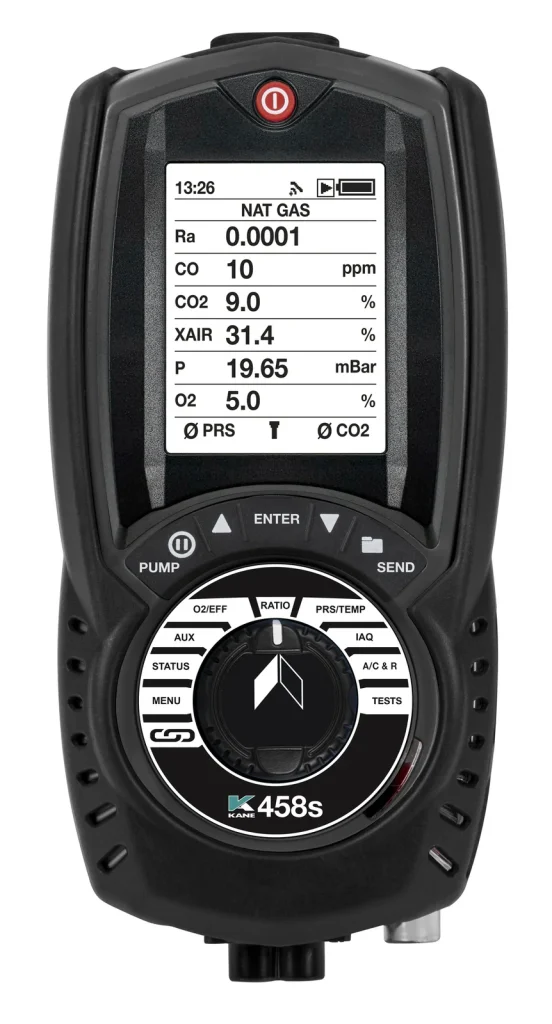
The KANE 458s is a lightweight portable flue gas analyser with direct O₂ and CO measurement, calculated CO₂, flue and ambient temperature, draught and combustion efficiency. The sensor platform is upgradeable, so the instrument can grow with your needs. It suits maintenance teams who tune small and medium boilers every week.
KANE 958
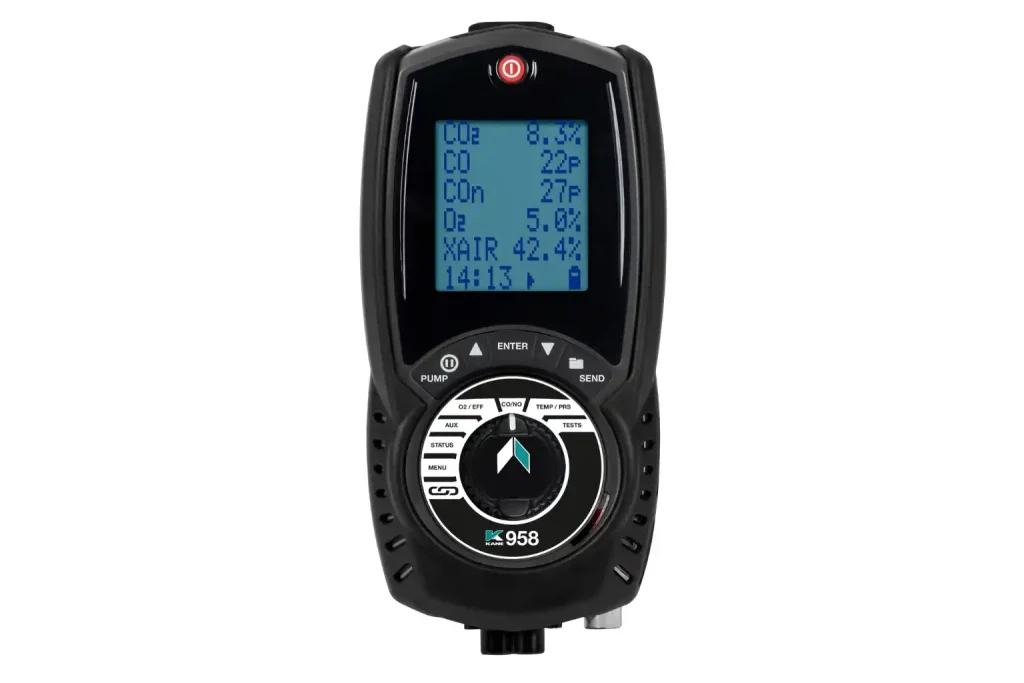
The KANE 958 is a fully upgradeable commercial flue gas analyzer. It measures O₂, CO and CO₂, with optional NO, NO₂ and SO₂ sensors, and has a CO sensor protection system that guards the cell when CO runs high during tuning. It fits plants that want NOx or SO₂ readings later without buying a new instrument.
KANE 988
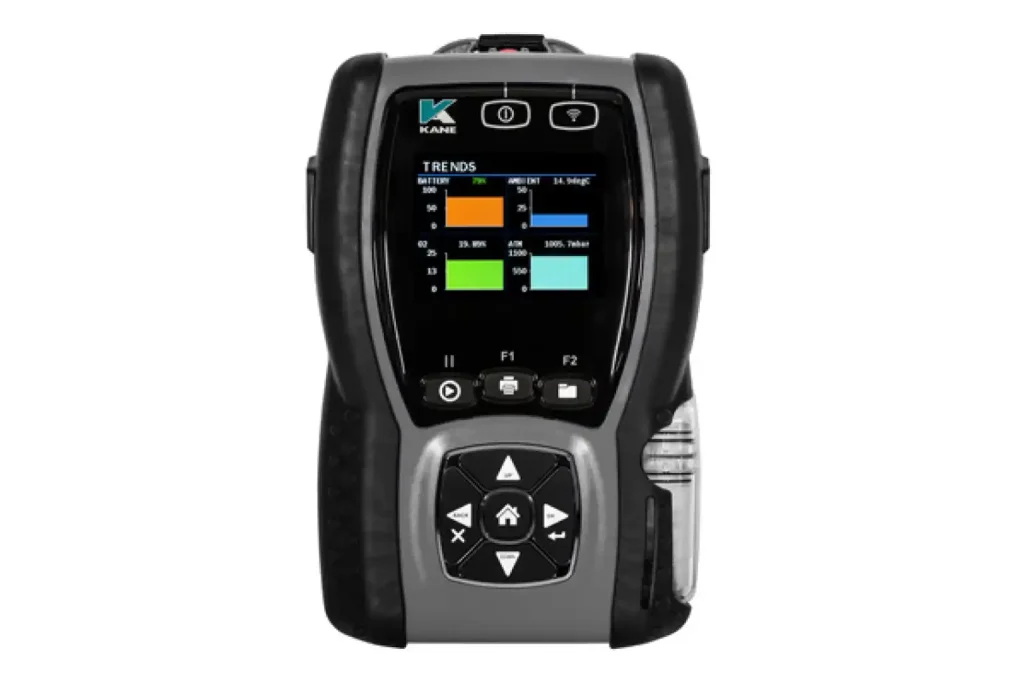
The KANE 988 measures up to 8 gases at once: O₂, CO, CO₂, HC, NO, NO₂, SO₂ and H₂S, plus flue temperature and combustion efficiency. It has advanced sensor protection, a large colour display and reporting functions. It suits energy auditors, combustion specialists and plants that test several fuels and stacks.
How to choose a flue gas analyser in India: a buying checklist
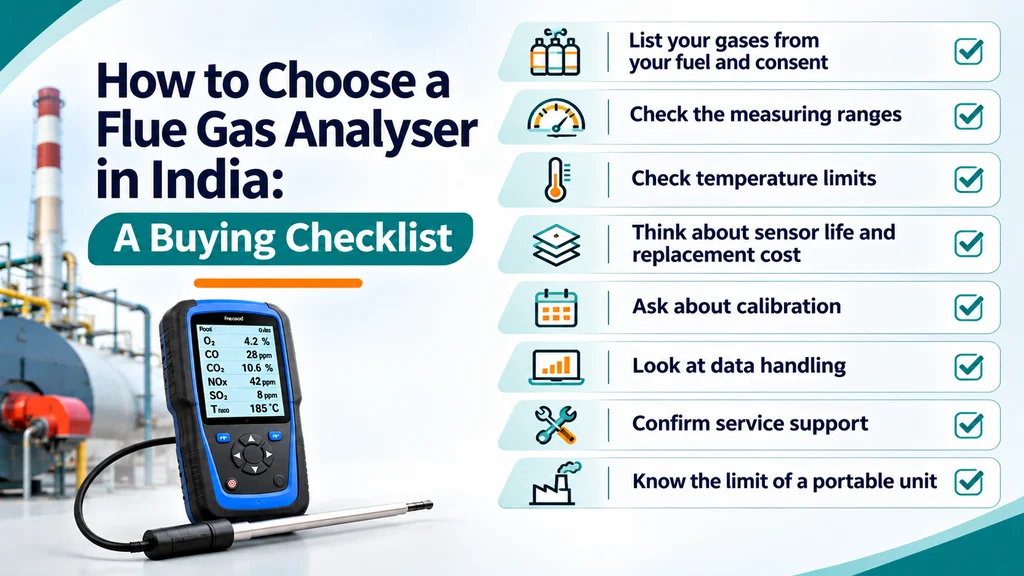
Go through these points before you ask for quotes. They save money and avoid the wrong instrument.
- List your gases from your fuel and consent. Gas-fired boilers usually need O₂, CO and NOx. Coal, furnace oil and petcoke users also need SO₂.
- Check the measuring ranges. CO during tuning can climb well above normal running levels. Make sure the CO range and sensor protection cover it.
- Check temperature limits. The probe must handle your flue temperature. Process furnaces and kilns run much hotter than package boilers.
- Think about sensor life and replacement cost. Electrochemical cells wear out. Ask what a replacement cell costs and how quickly it can be supplied in India.
- Ask about calibration. Find out who calibrates the instrument, how often, and how long it is away from your site.
- Look at data handling. Printouts, stored tests and wireless transfer make records easier for energy audits and internal reports.
- Confirm service support. A good analyser sitting in a box waiting for a part helps nobody. Ask where the service centre is and whether engineers are trained by the manufacturer.
- Know the limit of a portable unit. If your consent or a CPCB direction requires continuous stack data, a portable analyser does not meet it. You need an online system, and in Delhi NCR it must be one of the stack analysers allowed to send data.
Common mistakes when using a flue gas analyser
- Testing too soon. Readings taken before the boiler reaches steady load mislead. Give it time.
- Wrong probe position. A probe near the wall or near an air leak reads diluted gas and shows false high O₂.
- Skipping the fresh-air zero. Most portable units zero their sensors in clean air at start-up. Start in the boiler house next to the stack, and you start with an error.
- Ignoring the water trap. Condensate that reaches the sensors shortens their life.
- Selecting the wrong fuel. The efficiency and CO₂ calculations depend on the fuel you select. Coal set as gas gives a wrong efficiency figure.
Conclusion
Nevco Engineers started in 1982 as Combustion Analysers, so flue gas measurement is where our company began. Our 60+ sales and service engineers across India support the KANE range with supply, training, calibration and repair. For continuous measurement we also supply the OXY600 for O₂ trim and full stack monitoring systems.
Need help picking the right model?
Tell us your fuel, boiler size and the gases you need to measure, and we will recommend a KANE analyser and send a quote. Call +91-9999946668 or write to sales@nevcoengineers.com, Monday to Saturday, 10:00 AM to 6:00 PM.
FAQs
What is the use of a flue gas analyser?
A flue gas analyser measures the gases in a boiler or furnace exhaust, mainly O₂, CO, CO₂, NOx and SO₂, plus flue temperature. Plants use it to set the right air-to-fuel ratio, calculate combustion efficiency, reduce fuel waste and check emissions after maintenance or burner adjustment.
Is it flue gas analyser or flue gas analyzer?
Both are correct. “Analyser” is the British and Indian spelling, and “analyzer” is the American spelling. They describe the same instrument. Product names often keep the manufacturer’s spelling, so you will see both on the same page.
Which sensor is used in a flue gas analyser?
Most portable flue gas analysers use electrochemical sensors for O₂, CO, NO, NO₂, SO₂ and H₂S. Many use NDIR infrared sensors for CO₂ and hydrocarbons. Fixed multi-gas systems may use FTIR, while online oxygen analysers often use a zirconia sensor placed directly in the flue.
What is a good O₂ reading in flue gas?
The best O₂ reading is the lowest value at which CO stays low and stable. It varies with fuel, burner design and load, so gas burners can usually run leaner than coal or oil. Tune by reducing air in small steps while watching CO, then hold back slightly from the point where CO starts to rise.
Can a portable flue gas analyzer replace CEMS?
No. A portable flue gas analyzer gives spot readings when someone takes them. A CEMS measures continuously and, where required, sends data to CPCB and the state board. If your consent or a CPCB direction requires online stack monitoring, you need a CEMS. A portable unit then supports tuning and cross-checks.
How often should a flue gas analyser be calibrated?
Follow the manufacturer’s recommendation, which for most portable analysers is a service and calibration once a year. Sensors may need replacing at that visit. Calibrate sooner if readings drift, after a sensor change, or if the instrument has been dropped or exposed to condensate.