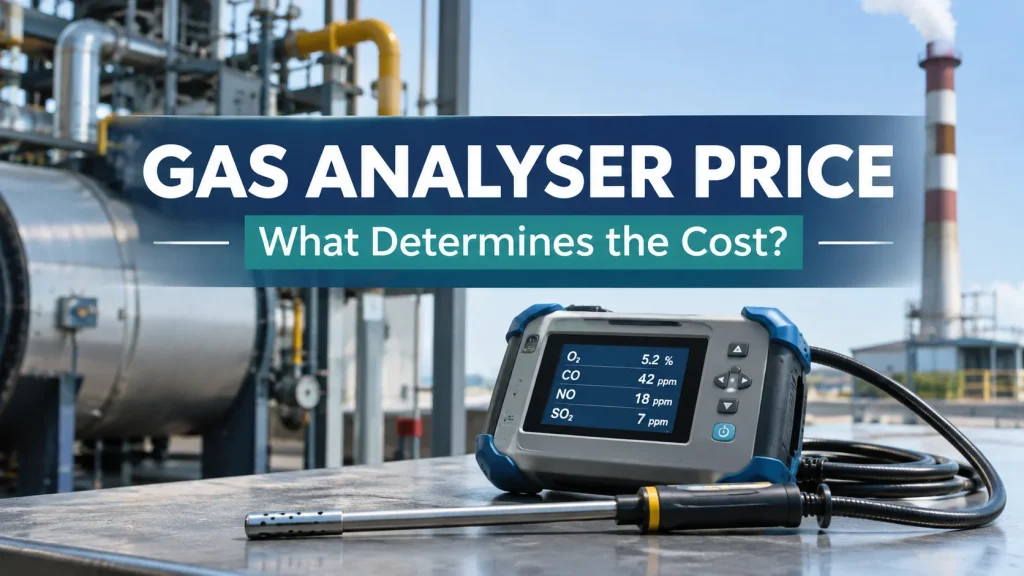
Quick answer: There is no single gas analyser price. In India, the cost depends mainly on five things: which gases you measure, the sensor technology, the certification the regulator expects, calibration and spares over the instrument’s life, and the brand and service behind it. A portable analyser for O₂ and CO costs a fraction of a certified multi-gas CEMS. The right way to compare is total cost over five years, not the purchase price.
Key takeaways
- Every extra gas adds a sensor, and the sensor technology sets most of the price.
- Portable analysers, fixed online analysers and full CEMS are different purchases, not cheaper and dearer versions of one product.
- If the data goes to CPCB, certification is not optional. In Delhi NCR, stack analysers must be CSIR-NPL certified.
- Calibration gas, replacement sensors and annual service can add up to more than you expect over five years.
- A quote is only comparable when it lists the same gases, ranges, accessories and service terms.
Request a quote: Tell us the gases you need, the application (boiler tuning, stack compliance, process or hydrogen purity), the fuel, and how many units. We will recommend a model and send a priced quote. Request a quote · Call +91-9999946668 · sales@nevcoengineers.com
Why is there no fixed gas analyzer price?
Because “gas analyser” covers instruments that do very different jobs. A handheld combustion analyser that a boiler technician carries in a bag and a stack analyser that sends certified data to CPCB around the clock are both gas analysers. Their prices differ for the same reason a weighing scale and a weighbridge differ.
Most gas analyser purchases in Indian industry fall into four groups:
| Type | Typical job | What you are paying for |
|---|---|---|
| Portable flue gas analyser | Boiler and burner tuning, energy audits, servicing | Sensors, pump, probe, display, reporting |
| Fixed online analyser | Continuous O₂ for burner trim, single gas process control | Rugged in-situ or extractive sensor, installation, signal output |
| Process and purity analyser | Hydrogen purity, specific process gases | Specialised sensors and ranges for one process |
| Continuous emission monitoring system (CEMS) | Stack compliance with live data to CPCB and the state board | Multi-gas analyser, certification, data logger, shelter, installation, calibration, connectivity |
Once you know which group you are in, the price drivers below decide where in that group your quote lands.
What decides the price of a gas analyser?
1. Which gases, and how many
Each gas usually needs its own sensor, so every gas you add raises the price. A basic portable unit that reads O₂ and CO, with CO₂ calculated, is the entry point. Add NO, NO₂, and SO₂, and the cost goes up with each cell. Gases such as HCl, HF, and NH₃ in wet stack gas need far more advanced technology.
Before asking for quotes, list the gases your fuel and consent actually need. Paying for sensors you never use is the most common way buyers overspend.
2. The sensor technology
The measurement principle sets most of the cost.
| Technology | Typical use | Effect on price |
|---|---|---|
| Electrochemical cells | O₂, CO, NO, NO₂, SO₂ in portable analysers | Lowest cost per gas; cells need replacing every few years |
| NDIR (infrared) | CO₂, CO, hydrocarbons | Moderate; stable with long sensor life |
| Zirconia | Fast in-situ O₂ in the flue | Moderate; built for continuous duty |
| FTIR, UV DOAS, laser (TDL) | Multi-gas CEMS, wet or corrosive gas, HCl, HF, NH₃ | Highest; one instrument can replace several, with low running cost |
A cheaper technology can be the expensive choice if it cannot cope with your gas. Electrochemical cells in a wet, acidic stack, for example, die quickly and lose data. We explain how each method works in our flue gas analyser explainer.
3. Measuring range and conditions
Higher temperatures, wider ranges, and harsh gases cost more. Probes for hot process furnaces and kilns cost more than probes for package boilers. Heated sample lines, filters and coolers for extractive systems add to the bill. Percent-level measurement for process gases or hydrogen purity needs different sensors from ppm-level emission work.
4. Certification and approvals
If the analyser’s data is used for compliance, certification is part of the price. CPCB’s monitoring rules expect analysers with recognised approvals, and in Delhi NCR only CSIR-NPL certified systems may send stack data to the government server. An uncertified analyser that cannot connect is not a saving. It is a second purchase waiting to happen. Check the stack analysers allowed to send data in NCR before you compare prices.
For portable analysers used for tuning and audits, no regulatory certification applies, but a traceable calibration certificate still matters.
5. Calibration, consumables and spares
The running cost decides whether a cheap analyser stays cheap. Budget for:
- Calibration: most portable analysers need an annual service and calibration. CEMS need regular zero and span checks, multipoint calibration and verification by empanelled labs.
- Calibration gases: cylinders of span gas for fixed systems, and their refills.
- Replacement sensors: electrochemical cells wear out and are the highest running cost of a portable unit.
- Filters, pumps and probe parts: small items that stop the instrument when they fail.
6. Brand, origin and service in India
You pay for the service network as much as the hardware. An analyser that has to go abroad for repair is out of action for weeks. Ask where the service centre is, whether engineers are trained by the manufacturer, and how quickly sensors and spares can be supplied. Imported instruments are also affected by exchange rates and duties, so quotes can change between enquiries.
7. Accessories, software and installation
Two quotes for the “same” analyser often differ only in what is included. Check for probes and hoses, printers, data software, carry cases, data loggers, shelters, installation and commissioning, and operator training. For CEMS, the data logger and connection to CPCB’s ODAMS portal are essential, not extras.
How do you compare two gas analyser quotes?
Put them side by side on total cost over five years, with the same scope. Use this table:
| Line to compare | Quote A | Quote B |
|---|---|---|
| Gases measured and ranges | ||
| Sensor technology for each gas | ||
| Certification and approvals | ||
| Accessories and software included | ||
| Installation, commissioning and training | ||
| Warranty period | ||
| Annual calibration or AMC cost | ||
| Sensor replacement cost and expected life | ||
| Calibration gas and consumables per year | ||
| Service centre location and response time | ||
| Estimated five-year total |
A lower purchase price with two sensor replacements and a week of downtime each year is rarely the better buy.
Which Nevco gas analyser fits your budget and job?
| Need | Analyser | What it measures |
|---|---|---|
| Routine boiler servicing on a tight budget | KANE 458s | O₂, CO, calculated CO₂, flue and ambient temperature, draught, efficiency |
| Tuning plus optional emissions gases later | KANE 958 | O₂, CO, CO₂, with optional NO, NO₂ and SO₂ |
| Full combustion and emissions analysis | KANE 988 | Up to 8 gases: O₂, CO, CO₂, HC, NO, NO₂, SO₂, H₂S |
| Continuous O₂ for burner trim | OXY600 | In-situ zirconia O₂ |
| Hydrogen purity in generators | Nova 380K | Portable tri-gas analysis for hydrogen purity |
| Vehicle exhaust testing | EGA 4 and 5 | Automotive exhaust gases |
| Stack compliance with data to CPCB | Continuous emission monitoring systems | Multi-gas, by industry and consent |
Get a quote for any of these analysers
What information gets you an accurate quote fastest?
Send these with your enquiry, and you will get a firm quote instead of a range:
- The gases and the ranges you expect.
- The application: boiler tuning, stack compliance, process control or purity.
- Fuel type and flue gas temperature.
- For fixed systems: stack diameter, gas moisture and dust load, and whether data must go to CPCB.
- Quantity, delivery location, and whether you need installation and training.
Common buying mistakes that cost more later
- Buying a portable unit to meet an online monitoring condition. If your consent requires continuous stack data, a portable analyser does not satisfy it.
- Choosing on purchase price alone. Sensor replacement and calibration can outweigh a small price gap within two years.
- Skipping certification checks. A stack analyser that cannot connect in NCR has to be replaced.
- Over-specifying. Eight gases on a gas-fired boiler that only needs O₂, CO and NOx is money spent for nothing.
- Ignoring service. The cheapest analyser is expensive when it waits a month for a part.
How Nevco helps
Nevco Engineers began in 1982 as Combustion Analysers and has supplied gas analysers to Indian industry for 44 years. Our 60+ sales and service engineers across India handle supply, installation, training, calibration, and repair, including instruments not supplied by us.
Ready for a price? Send us your gases, application, and quantity, and our engineers will recommend the right analyser and quote it. Call +91-9999946668 or write to sales@nevcoengineers.com, Monday to Saturday, 10:00 AM to 6:00 PM.
FAQs
What is the price of a gas analyser in India?
There is no single price. A portable analyser that measures O₂ and CO sits at the low end, multi-gas portable units cost more, and a certified CEMS with installation and CPCB connectivity is a much larger investment. The gases, sensor technology, certification, and service terms decide the figure. Ask for a quote with your exact gases and application.
Why are some flue gas analysers much cheaper than others?
Cheaper units usually measure fewer gases, use only electrochemical cells, come with fewer accessories, or have limited service support in India. They can suit routine boiler checks. They are a poor buy where you need many gases, wet or corrosive gas, certified data, or quick repair.
What is the running cost of a portable flue gas analyzer?
The main running costs are the annual service and calibration and the replacement of electrochemical sensors as they age. Filters, pump parts, and probe accessories add a little more. Ask the supplier for sensor replacement prices and expected life before you buy.
Does a gas analyser need certification in India?
Portable analysers used for tuning and audits need a traceable calibration certificate but no regulatory approval. Analysers whose data goes to CPCB for compliance must meet CPCB’s requirements, and in Delhi NCR stack analysers must be CSIR-NPL certified to connect to the government server.
Is it cheaper to buy one multi-gas analyser or several single-gas units?
For stack compliance, one multi-gas analyser using FTIR, DOAS or laser technology usually costs less to run than several single-gas analysers, because it needs fewer spares and calibrations. For portable work, one multi-gas unit is simpler than carrying several instruments.
What should I send to get a gas analyser quote?
Send the gases and ranges you need, the application, the fuel and flue gas temperature, the quantity, and the delivery location. For fixed systems and CEMS, add stack diameter, moisture and dust load, and whether data must go to CPCB. A site survey may be needed for larger systems.