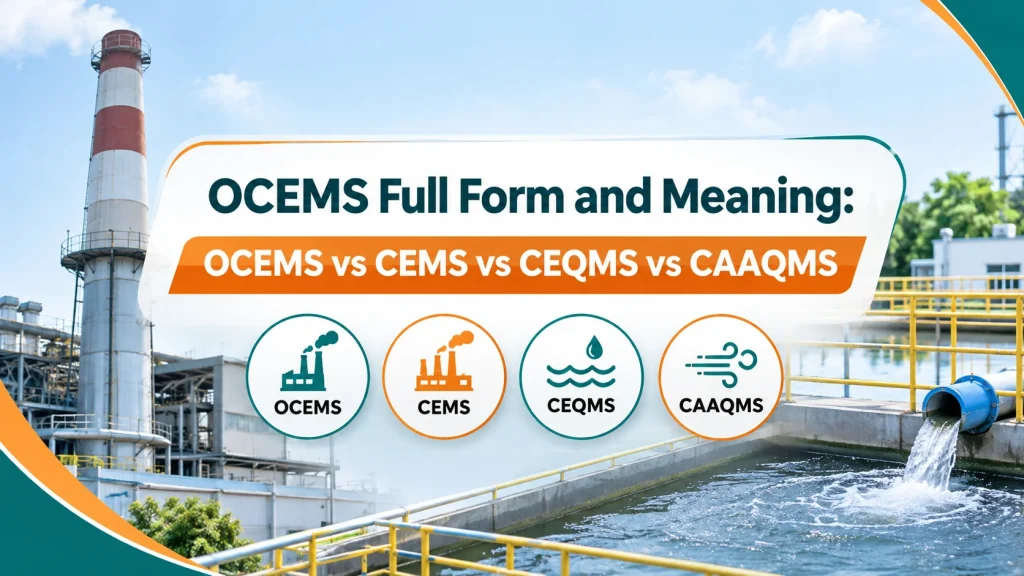
Quick answer: OCEMS stands for Online Continuous Emission/Effluent Monitoring System. It is the Central Pollution Control Board’s (CPCB) umbrella term for analysers that measure a plant’s stack emissions or treated effluent around the clock and send the readings live to CPCB and state board servers. CEMS covers the stack, CEQMS covers effluent, and CAAQMS covers the surrounding air.
Key takeaways
- OCEMS is one umbrella term. The “E” stands for emission (air from the stack) or effluent (wastewater from the outlet), depending on what the system monitors.
- CEMS measures pollutants inside a chimney. CEQMS measures treated wastewater. CAAQMS measures the ambient air around a plant or city.
- CPCB first required OCEMS from the 17 categories of highly polluting industries, common effluent treatment plants and common waste incinerators, with a deadline of 31 March 2015.
- All 17 categories sit in CPCB’s Red category, but not every Red category unit falls in the 17. Your Consent to Operate is the final word on what you must install.
- Since 31 August 2025, OCEMS data goes to CPCB through its ODAMS portal.
What is the full form of OCEMS?
OCEMS full form: Online Continuous Emission/Effluent Monitoring System. CPCB writes it both ways, sometimes as “Online Continuous Effluent & Emission Monitoring Systems”, as in its 2018 compliance reporting protocol for industries.
Each word tells you something:
- Online: the analyser is connected. Readings travel to the regulator’s server without anyone emailing a report.
- Continuous: it measures all day, every day, not once a quarter.
- Emission or Effluent: emission means gases and dust leaving a stack. Effluent means treated wastewater leaving your ETP or STP.
- Monitoring System: the full chain, from the sensor or analyser to the data logger that sends readings out.
So when a state board officer asks, “Is your OCEMS connected?”, he could mean your stack analyser, your effluent analyser or both. It depends on what your consent order lists.
What is the OCMS full form?
People often type “OCMS” when they mean OCEMS. Read as written, OCMS is simply an Online Continuous Monitoring System, the same idea without the emission or effluent tag. Some state boards also use their own versions. Kerala and Karnataka, for example, use OCEEMS (Online Consent Effluent and Emission Monitoring System) for their wider programmes. The hardware and the purpose are the same: live, continuous data to the regulator.
OCEMS vs CEMS vs CEQMS vs CAAQMS: what is the difference?
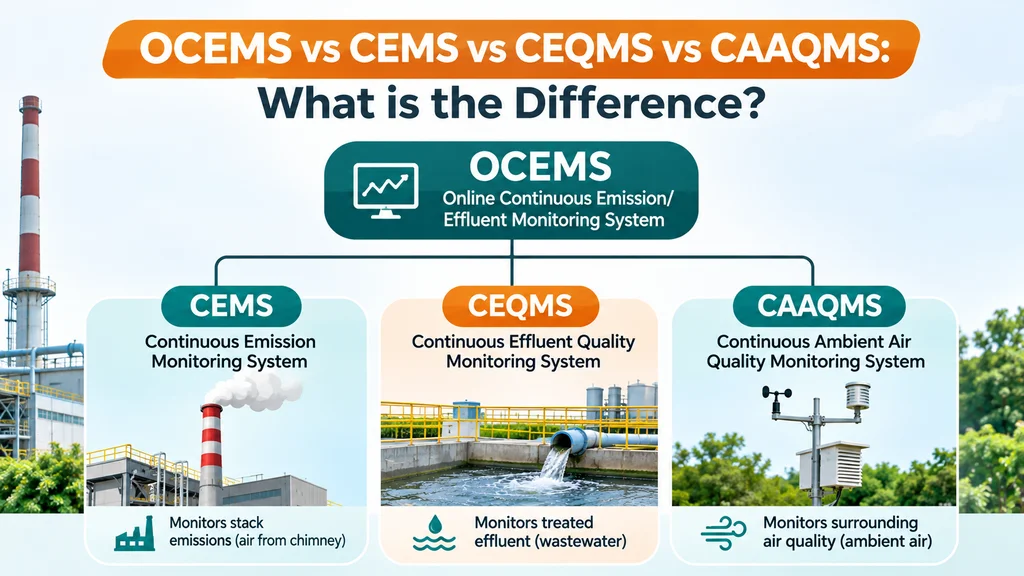
The short version: OCEMS is the family name, and CEMS and CEQMS are its two members. CAAQMS is a close cousin that watches the open air. Each one answers a different question.
| Point | CEMS | CEQMS | CAAQMS |
|---|---|---|---|
| Full form | Continuous Emission Monitoring System | Continuous Effluent Quality Monitoring System | Continuous Ambient Air Quality Monitoring System (or Station) |
| Part of OCEMS? | Yes, the emission side | Yes, the effluent side | No. It measures ambient air, not your discharge |
| Where it sits | On or inside the stack (chimney) | At the treated effluent outlet of the ETP, CETP or STP | Outdoors, at the plant boundary or in a city |
| What it measures | Industry specific: PM, SO₂, NOx, NH₃, HCl, HF, Cl₂, CO, Hg and others, plus O₂ or CO₂, temperature and flow | pH, COD, BOD, TSS and flow, plus sector-specific parameters | Ambient gases such as SO₂, NO₂, O₃, CO and benzene, PM10 and PM2.5, and weather data |
| Question it answers | “Is my stack within its emission limit right now?” | “Is my discharge within its effluent standard right now?” | “What is the air quality people are breathing near my plant?” |
| Who installs it | Units directed by CPCB or named in the consent order | Units that discharge effluent and are directed by CPCB or the consent | Government monitoring networks, plus industries whose consent or clearance asks for it |
| Data goes to | CPCB (through ODAMS) and the state board | CPCB (through ODAMS) and the state board | State board and CPCB, as the consent or programme requires |
| Nevco systems | continuous emission monitoring range: AR602Z, LD500, AR650, System 400 | continuous effluent quality monitoring system | AR 500 OPSIS air quality monitoring system |
One mistake we see often: a plant installs a boundary CAAQMS and believes its stack is now covered. It is not. A CAAQMS tells the board about the air outside your wall. It says nothing about what your chimney is releasing. These are separate duties with separate equipment.
Which CPCB category of industries must install OCEMS?
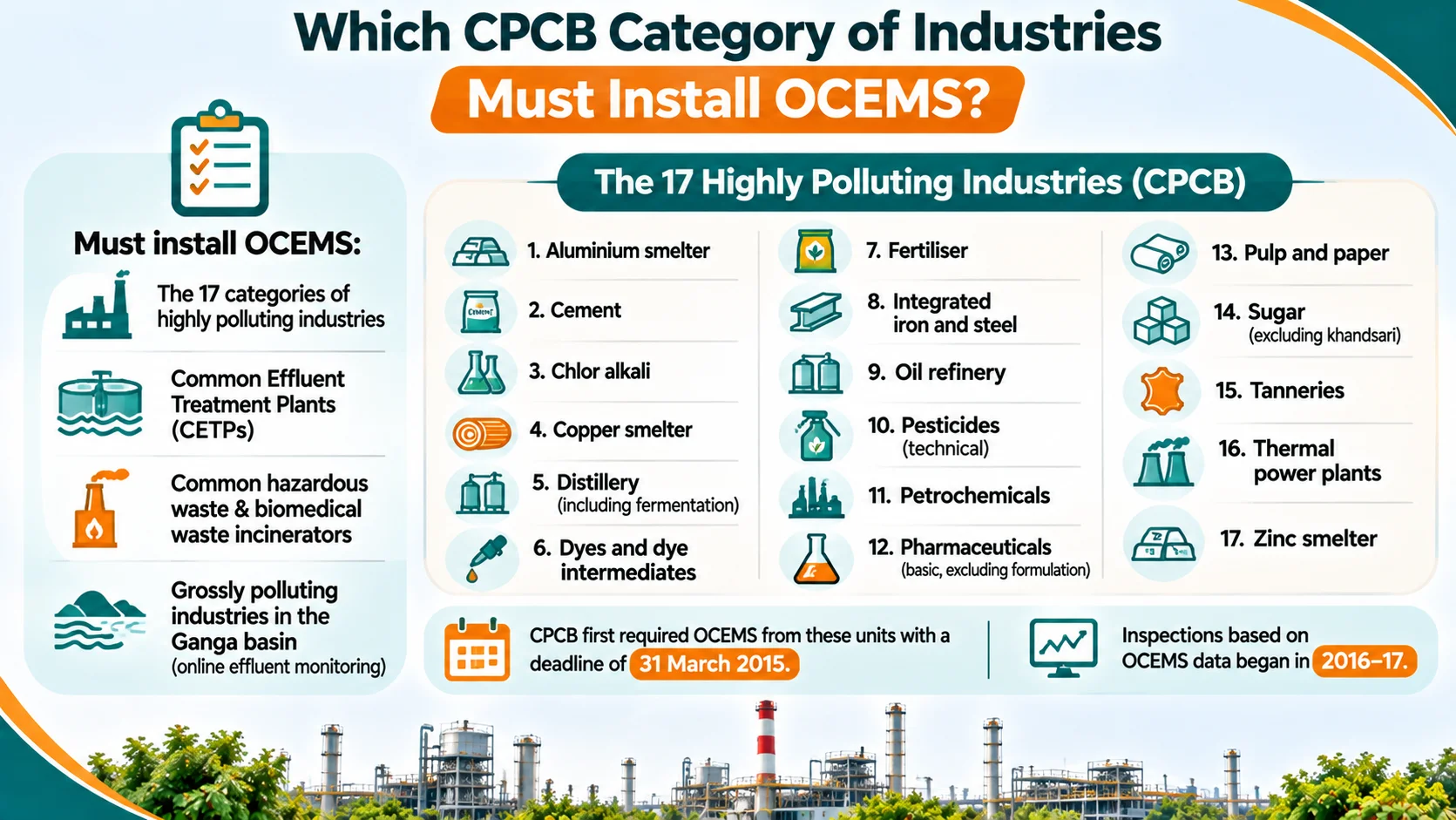
The core group is the 17 categories of highly polluting industries, plus common treatment facilities. In 2014, CPCB directed state boards to make these units install online emission and effluent monitoring and transmit the data, with a deadline of 31 March 2015. Inspections based on computer-generated alerts from OCEMS began in 2016-17.
The 17 categories, as listed by the government:
- Aluminium smelter
- Cement
- Chlor alkali
- Copper smelter
- Distillery (including fermentation)
- Dyes and dye intermediates
- Fertiliser
- Integrated iron and steel
- Oil refinery
- Pesticides (technical)
- Petrochemicals
- Pharmaceuticals (basic, excluding formulation)
- Pulp and paper
- Sugar (excluding khandsari)
- Tanneries
- Thermal power plants
- Zinc smelter
The same directions also covered common effluent treatment plants (CETPs) and common hazardous waste and biomedical waste incinerators. Grossly polluting industries in the Ganga basin were directed to install online effluent monitoring as well.
Where does the Red category fit?
CPCB sorts industries into Red, Orange, Green and White categories by pollution potential. All 17 highly polluting categories fall in the Red category, but the Red list is much longer than 17. Being Red does not by itself mean you must install OCEMS. Being one of the 17, or being named in a CPCB direction or your consent, does.
There are other routes in too:
- Boilers: G.S.R. 96(E), notified on 29 January 2018 under the Environment (Protection) Act, 1986, requires CEMS on boilers used in industries such as sugar, cotton textile, composite woollen mills, synthetic rubber, pulp and paper, distilleries, leather and carbon black, among others.
- New units: CPCB has directed that units in the 17 categories commissioned after 28 February 2017 install OCEMS and connect it to the CPCB and state board servers before they start operating.
- NCR: CPCB has directed state boards to make Red category air-polluting industries across the National Capital Region install online stack monitoring for the parameters in their consent.
Who must install which system? A quick self-check
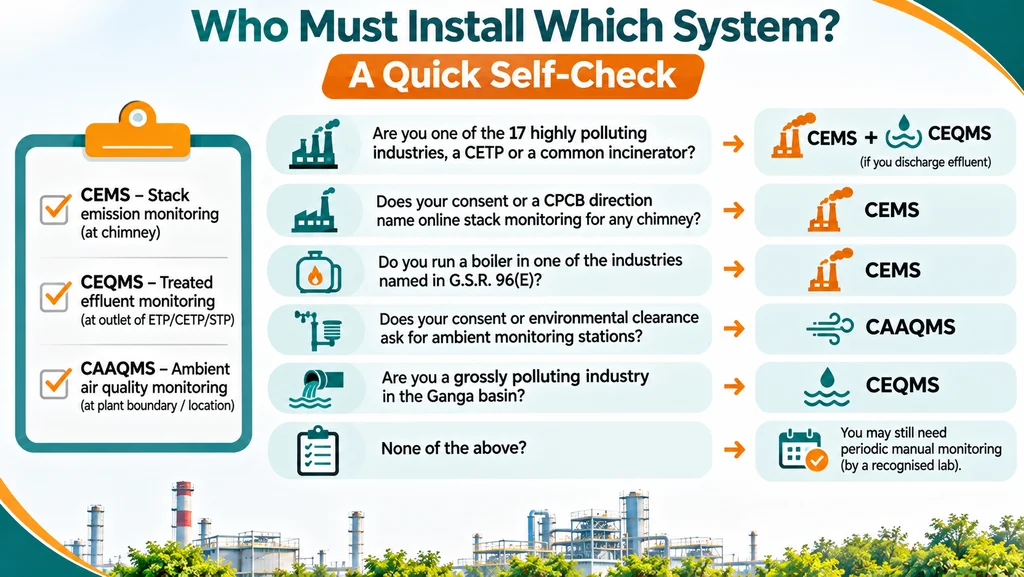
Answer these against your Consent to Operate. Each “yes” points to a system.
- Are you one of the 17 categories, a CETP or a common incinerator? Yes: CEMS on your stacks, and CEQMS on your effluent outlet if you discharge.
- Does your consent or a CPCB direction name online stack monitoring for any chimney? Yes: CEMS for the parameters it lists.
- Do you run a boiler in one of the industries named in G.S.R. 96(E)? Yes: CEMS on that boiler stack.
- Does your consent or environmental clearance ask for ambient monitoring stations? Yes: CAAQMS at the locations it specifies.
- Are you a grossly polluting industry in the Ganga basin? Yes: CEQMS at the treated effluent outlet.
- None of the above? You may still need periodic manual monitoring by a recognised lab. Check the monitoring clause of your consent.
How does OCEMS data reach CPCB now?
Through ODAMS, CPCB’s Online Data Acquisition and Management System, live since 31 August 2025. Every OCEMS unit, whether CEMS or CEQMS, must be registered on ODAMS with each stack or outlet and each parameter mapped correctly. Registration on the old OCEMS portal is no longer enough, and CPCB has already listed defaulters for closure. We explain the full change and why old portal registration does not protect your plant after ODAMS.
If your plant is in Delhi NCR, there is one more condition. Only analysers certified by CSIR-NPL can connect, so check the stack analysers allowed to send data in NCR before you buy.
Common mistakes plants make with OCEMS
- Treating CAAQMS as stack compliance. Ambient data cannot replace emission data. The board will still ask for your stack readings.
- Monitoring the wrong parameters. The parameter list comes from your consent and industry standards. A cement kiln, a sugar boiler, and a fertiliser plant each need different gases.
- Installing, then forgetting. An analyser that drifts or a logger whose SIM expires shows up on the portal as missing data. Missing data reads the same as no monitoring at all.
- Ignoring calibration. CPCB rules require periodic calibration checks, and PM monitors must be calibrated against manual isokinetic sampling. An uncalibrated OCEMS gives numbers nobody trusts.
How Nevco helps
Nevco Engineers has supplied environmental monitoring systems to Indian industry for 44 years, since 1982. We supply, install and maintain both sides of OCEMS and the ambient stations that sit beside them:
- Stack (CEMS): the AR602Z UV spectrometer, the LD500 laser cross-stack analyser, the AR650 multi-component analyser and the System 400.
- Effluent (CEQMS): online pH, COD, BOD and TSS measurement through our continuous effluent quality monitoring system.
- Ambient (CAAQMS): the AR 500 OPSIS station with the SM 200 for dust.
- Connectivity: the NEVCO NV-LX IoT data logger, built to the CPCB communication protocol.
Not sure which system your consent actually requires?
Send us your Consent to Operate, and our engineers will tell you which stacks, outlets, and parameters need online monitoring, and what you already have that can be reused. Call +91-9999946668 or write to sales@nevcoengineers.com, Monday to Saturday, 10:00 AM to 6:00 PM.
FAQs
What is the full form of OCEMS in pollution control?
OCEMS stands for Online Continuous Emission/Effluent Monitoring System. CPCB uses it for any analyser that measures stack emissions or treated effluent continuously and sends the data online to CPCB and the State Pollution Control Board. It covers both CEMS for stacks and CEQMS for effluent.
Is OCEMS the same as CEMS?
Not exactly. CEMS, the Continuous Emission Monitoring System, is the stack side of OCEMS. OCEMS is the broader term, and it also includes CEQMS for effluent. When people say OCEMS for a chimney, they mean CEMS. When they say it for an ETP outlet, they mean CEQMS.
What is the difference between CEMS and CAAQMS?
A CEMS measures pollutants inside a stack, at the point of release, against your emission limit. A CAAQMS measures pollutants in the open air around your plant or city against ambient air quality standards. Many large plants need both, because one does not replace the other.
Which industries need OCEMS in India?
The 17 categories of highly polluting industries, common effluent treatment plants and common hazardous and biomedical waste incinerators were the first to be directed. Boilers in industries named in G.S.R. 96(E) of 2018, Red category air-polluting units in NCR, and grossly polluting industries in the Ganga basin have also been brought in.
Where is OCEMS data uploaded now?
OCEMS data now goes to CPCB’s ODAMS portal (Online Data Acquisition and Management System), live since 31 August 2025. Each unit must register directly, map every stack or outlet and parameter, and keep data flowing. Registration on the old OCEMS portal alone no longer counts as compliance.