
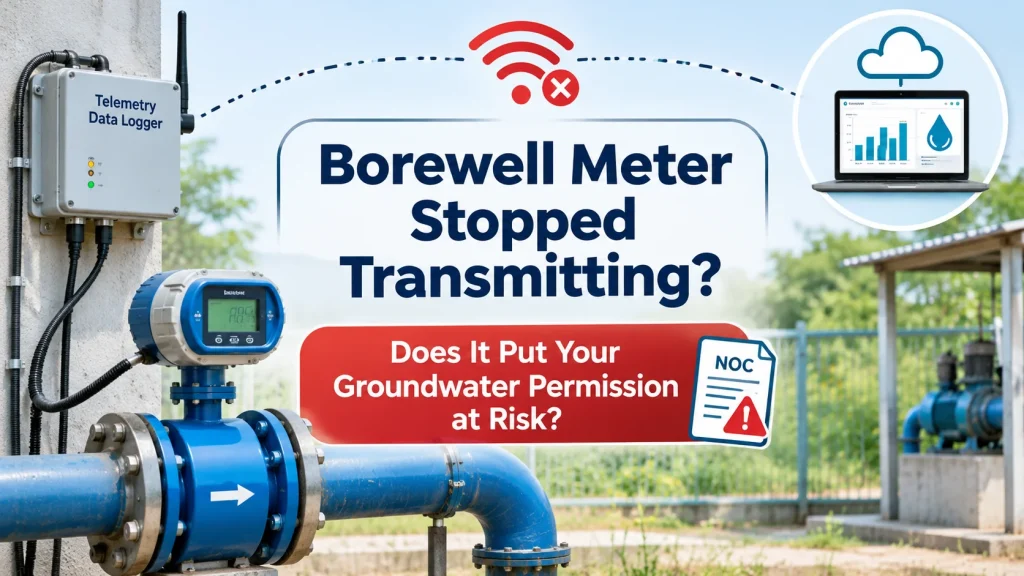
Quick answer: Yes, it can. Your groundwater NOC requires a digital water flow meter with telemetry on every borewell, and the CGWA guidelines of 24 September 2020 list a penalty of Rs 2,00,000 for a meter with telemetry that is not installed or is faulty. Most telemetry failures come from the SIM, power, data logger, or sensor, and are quick to fix once found.
Key takeaways
- Under Clause 9.0(i) of the CGWA guidelines dated 24 September 2020, every NOC applicant must install a digital water flow meter with telemetry and report it on the CGWA portal within 30 days of NOC grant.
- Meters must be calibrated by an authorised agency once a year, as per Clause 9.0(ii).
- Table 16.1 of the guidelines lists Rs 2,00,000 for a non-installed or faulty flow meter with telemetry, and Rs 1,00,000 for a non-installed or faulty DWLR or telemetry system on a piezometer.
- Telemetry usually stops for one of four reasons: an expired or weak SIM, a power problem, a data logger fault, or a sensor fault.
- A short diagnosis, done in order, finds most faults in a single site visit.
What do the CGWA conditions say about meters and telemetry?
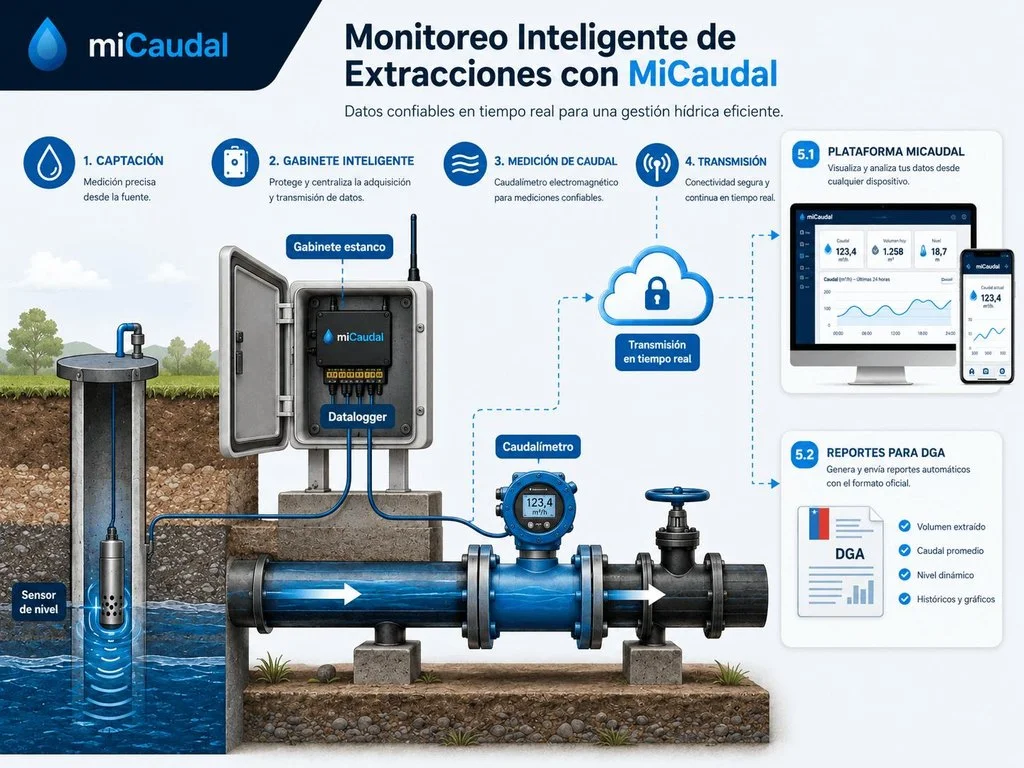
Your NOC treats live metering as a condition, not an extra. If the meter stops sending data, you are out of line with that condition even if the borewell itself is working normally.
The Central Ground Water Authority (CGWA), under the Ministry of Jal Shakti, issued its guidelines to regulate groundwater extraction on 24 September 2020. You can read them in our copy of the CGWA guidelines (PDF), and our earlier post explains what the CGWA notification requires.
The parts that matter for metering are:
- Flow meter with telemetry (Clause 9.0(i)): a digital flow meter with a telemetry system, conforming to BIS standards, is mandatory for all NOC applicants. Installation must be reported to CGWA through the web portal within 30 days of the NOC.
- Annual calibration (Clause 9.0(ii)): the meter must be calibrated by an authorised agency once a year.
- Piezometers (Section 14.0): units drawing more than 10 m³/day must build piezometers to monitor groundwater level, with the monitoring method set by volume.
- Data on the portal (Clause 9.0(v)): water level data goes to CGWA through its web portal.
NOCs issued under these guidelines repeat the requirement in their own words. A typical recent NOC says tamper-proof digital flow meters with telemetry are mandatory on all abstraction structures, with installation to be intimated within 30 days. A CGWA public notice also requires NOC holders to fit tamper-proof digital flow meters with telemetry on all abstraction structures in their premises.
| Groundwater withdrawal (m³/day) | Piezometers required | Monitoring method |
|---|---|---|
| Less than 10 | 0 | None |
| 11 to 50 | 1 | Manual |
| 51 to 500 | 1 | DWLR |
| More than 500 | 2 | 1 DWLR and 1 DWLR with telemetry |
Source: CGWA guidelines dated 24 September 2020, Table 14.1. DWLR stands for digital water level recorder.
Why does borewell telemetry stop transmitting?
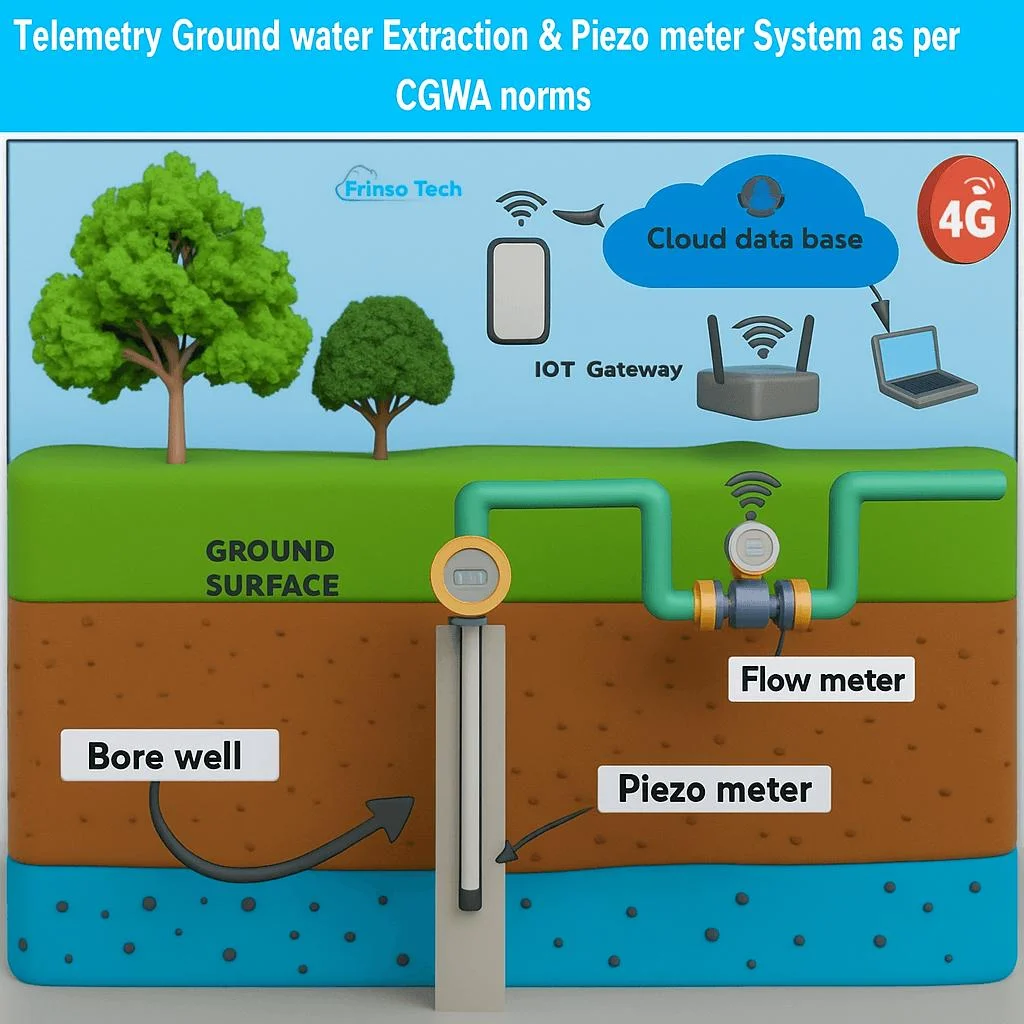
Most failures sit in four places, and three of them have nothing to do with the meter’s accuracy. The meter can be measuring correctly while nothing reaches the server.
- SIM and network. The data pack has expired, the SIM was deactivated for non-use, or the signal at the pump house is too weak. Borewells are often in remote corners of a site, where coverage drops.
- Power. The logger shares a supply that trips with the pump, the backup battery is dead, or a solar panel is dirty or shaded. A logger that loses power at night sends nothing until morning.
- Data logger or telemetry unit. Wrong server settings after a reset, a full memory, a clock error or a failed modem board. Lightning and voltage surges damage these units often.
- Sensor and wiring. A loose or corroded cable between the meter and the logger, water inside a junction box, or a flow sensor fouled by silt or iron deposits from the borewell water.
The tricky part is that the pump keeps running, so nobody on site notices. The gap shows up only on the portal.
5-step diagnosis checklist for a borewell meter that stopped transmitting
Work through these five steps in order. Each one rules out a layer, so you do not replace an expensive part for a cheap fault.
- Check the meter display. Is the flow meter powered and showing a live flow rate and a rising totaliser while the pump runs? If the display is blank or frozen, the fault is at the meter or its power.
- Check power to the logger. Look at the supply, the fuse, the backup battery and any solar panel. Note whether the logger restarts when the pump starts. A logger that dies with the pump needs a separate supply.
- Check the SIM and signal. Confirm the SIM is active and the data pack is valid. Check the signal strength shown on the logger. Try the SIM in a phone at the same spot if you have no other way to test.
- Check the logger settings and memory. Confirm the server address, the device ID, and the clock. See whether readings are stored locally but not sent. Stored data can often be pushed once the link is back.
- Check the signal from the sensor. Inspect the cable and connectors between the meter and logger for damage, corrosion, or water. Compare the meter’s display with the value the logger records. A mismatch points to the wiring or the signal configuration.
Write down what you find at each step, with the date and time. That record helps if you later need to explain the gap.
How do you restore data once you find the fault?
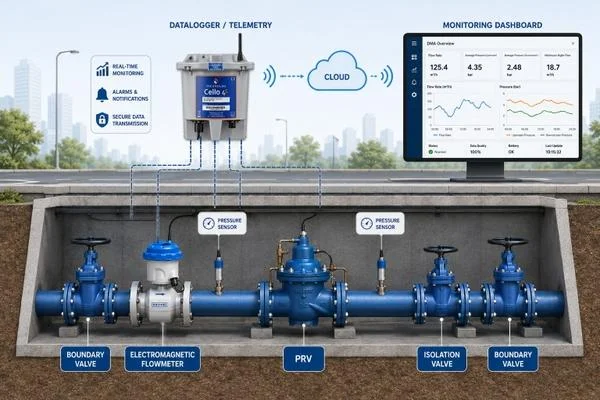
Fix the layer that failed, confirm data arrives, and keep proof.
- Fix the fault. Recharge or replace the SIM, restore power, reconfigure or replace the logger, or repair the wiring.
- Send stored data. If the logger kept readings during the outage, push them to the server.
- Confirm on the receiving side. Check that fresh readings appear at the portal or dashboard your telemetry reports to. Do not rely on the logger’s own screen.
- Recalibrate if the meter was opened. If the meter or sensor was removed or repaired, get it calibrated by an authorised agency, as Clause 9.0(ii) requires calibration every year in any case.
- Keep the records. File the service report, calibration certificate and screenshots of restored data with your NOC papers.
Does a stopped meter put your NOC at risk?
It can. The guidelines treat a faulty meter with telemetry the same way as a missing one, and they give the authorities stronger powers on top of penalties.
| Item in Table 16.1 of the CGWA guidelines | Penalty listed |
|---|---|
| Digital flow meter with telemetry not installed or faulty | Rs 2,00,000 |
| Piezometer not installed | Rs 2,00,000 |
| DWLR or telemetry system not installed or faulty | Rs 1,00,000 |
| Water level or quality data not submitted | Rs 50,000 |
| Withdrawal log book not maintained, or abstraction data not submitted | Rs 50,000 |
Source: CGWA guidelines dated 24 September 2020, Section 16.
Section 10.0 of the guidelines also lets District Collectors and District Magistrates seal abstraction structures, disconnect electricity, launch prosecution and impose environmental compensation. NOCs issued under the guidelines state that non-compliance with their conditions may lead to cancellation of the NOC.
That does not mean every short outage ends in action. It does mean a meter that stays silent for weeks, with no record of repair, leaves you exposed at inspection or renewal. Fixing it quickly and documenting the fix is the sensible course.
How do you stop it happening again?
- Check data weekly. Have one person look at the received data once a week, not just the meter display.
- Put the SIM on auto-renewal or a long-validity plan, and note its expiry date in your maintenance calendar.
- Give the logger its own protected supply, with a healthy backup battery and surge protection.
- Seal junction boxes and route cables away from water and moving equipment.
- Book annual calibration well before the due date, and ask for a telemetry check on the same visit.
A situation we see often. A plant’s borewell meter shows a healthy flow on its display, so everyone assumes all is well. When our engineer checks, the logger’s SIM data pack expired months ago. The meter was working the whole time, but none of its data left the site. The fix took a recharge and a reconfiguration. Finding it took someone looking at the receiving end.
How Nevco helps with borewell metering
We supply and service flow meters and help you get their data where it needs to go. Nevco has worked in environmental monitoring since 1982, with 1,000+ water monitoring stations in our installed base.
- Electromagnetic flow meters for borewell delivery lines: see our electromagnetic flow meter range.
- Ultrasonic clamp-on flow meters that fit outside the pipe: see our ultrasonic clamp-on flow meter page.
- 60+ sales and service engineers across India, with full calibration facilities at our service centres.
- Repairs for any make, including meters and loggers Nevco did not supply.
Get your borewell telemetry checked. Call +91-9999946668 or email sales@nevcoengineers.com, Monday to Saturday, 10:00 AM to 6:00 PM..
FAQs
Is a flow meter with telemetry mandatory for a groundwater NOC?
Yes. Clause 9.0(i) of the CGWA guidelines dated 24 September 2020 makes a digital water flow meter with a telemetry system, conforming to BIS standards, mandatory for all NOC applicants. Installation must be reported to CGWA through its web portal within 30 days of the NOC being granted. NOCs issued under the guidelines repeat this as a condition.
What is the penalty if my borewell meter stops working?
Table 16.1 of the CGWA guidelines dated 24 September 2020 lists a penalty of Rs 2,00,000 for a digital flow meter with telemetry that is not installed or is faulty. The guidelines also allow authorities to seal structures, disconnect electricity, launch prosecution and impose environmental compensation, and NOCs say non-compliance may lead to cancellation.
Why does my borewell meter show readings but send no data?
The meter can measure correctly while the telemetry link fails. Common causes are an expired SIM data pack, a weak signal at the pump house, a logger that loses power when the pump stops, wrong server settings after a reset, or damaged wiring between the meter and the logger. Check each layer to find the break.
How often must a borewell flow meter be calibrated?
Once a year. Clause 9.0(ii) of the CGWA guidelines dated 24 September 2020 requires proponents to get the water flow meter calibrated by an authorised agency annually. If the meter or sensor is removed or repaired between calibrations, it is sensible to get it checked again before relying on its readings.
Do I need a piezometer with telemetry as well?
It depends on how much groundwater you draw. Under Table 14.1 of the CGWA guidelines, units drawing 11 to 50 m³/day need one manually monitored piezometer, 51 to 500 m³/day need one with a DWLR, and above 500 m³/day need two, one of them with a DWLR and telemetry. Below 10 m³/day, none is required.
Can Nevco check a borewell meter we bought from someone else?
Yes. Nevco repairs and calibrates instruments even if we did not supply them. Our 60+ sales and service engineers across India can check the meter, the logger, the SIM, and the wiring, and give you a service report for your records. Call +91-9999946668 or email sales@nevcoengineers.com