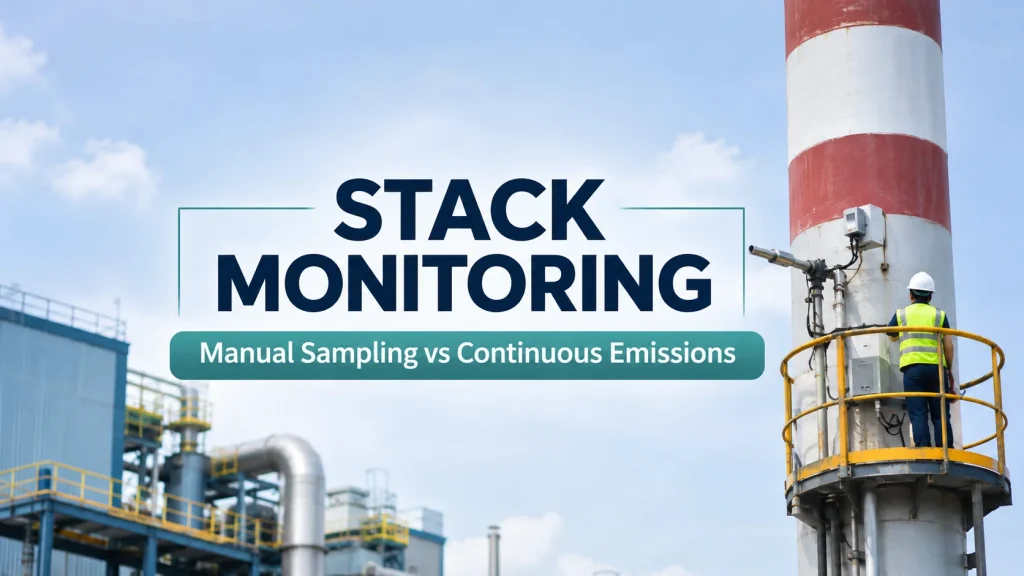
Quick answer: Stack monitoring is the measurement of particulate matter and gases leaving an industrial chimney, checked against the limits in your Consent to Operate. In India, it is done in two ways: manual stack sampling by a recognised laboratory at the frequency your state board sets, and continuous emission monitoring (CEMS) that sends live data to CPCB. Plants with CEMS still need periodic manual sampling to calibrate and verify it.
Key takeaways
- Manual stack monitoring gives a snapshot. CEMS gives a continuous record. CPCB treats them as partners, not substitutes.
- Your Consent to Operate sets which stacks, which parameters, and how often. CPCB’s Emission Regulations Part III set how stacks and sampling are done.
- Every stack monitoring report must show the flue gas flow rate and the production during sampling, not just the pollutant results.
- PM CEMS is calibrated against manual isokinetic sampling, and gaseous CEMS has its own zero, span, and multipoint calibration schedule.
- Design the stack with proper sampling ports and a platform first. Poor port location ruins both manual and continuous results.
What is stack monitoring?
Stack monitoring, also called stack emission monitoring or source emission monitoring, is the measurement of what a chimney releases into the air. It covers particulate matter (PM) and gases such as SO₂, NOx, CO, NH₃, HCl and HF, along with the conditions needed to report them correctly: gas velocity, flow rate, temperature, moisture and O₂ or CO₂.
The results are compared with the emission limits in your consent, which come from the industry-specific standards notified under the Environment (Protection) Act, 1986. For boilers, the limit depends on capacity and fuel, which we set out in our table of boiler stack emission limits.
What are the methods of stack monitoring?
There are two methods: manual (periodic) stack sampling and continuous emission monitoring (CEMS). Here is how they compare.
| Point | Manual stack sampling | CEMS (online stack monitoring system) |
|---|---|---|
| What it is | A team samples the stack on a fixed day with a sampling train and analyses the results | An analyser fixed on the stack measures around the clock |
| How PM is measured | Isokinetic sampling: gas is drawn into the nozzle at the same velocity as the stack gas, and dust is collected on a filter and weighed | Optical, triboelectric or similar probes, calibrated against isokinetic sampling |
| How gases are measured | Absorption and lab analysis, or a portable analyser on site | In-situ or extractive gas analysers |
| Result | One set of numbers for the sampling period | Continuous data, averaged as your consent requires |
| Data to the regulator | A report submitted to the state board | Live data to CPCB through ODAMS and to the state board |
| Who carries it out | A laboratory recognised or empanelled by CPCB or the state board | The plant runs it; empanelled labs verify it |
| Typical use | Every stack named in the consent, at its set frequency | Stacks of units directed by CPCB or required by consent |
| Main weakness | Misses what happens between visits | Only as good as its calibration and data connectivity |
How manual stack sampling works
CPCB sets the procedure in its Emission Regulations Part III (COINDS/20/1984-85) and its stack monitoring manual on isokinetic sampling. Laboratories also use IS 11255 and US EPA reference methods. A typical survey runs like this:
- Check the sampling location. The ports should sit at least 8 stack diameters downstream and 2 diameters upstream of any bend, damper or fan, so the flow is steady.
- Measure velocity and temperature across the stack with a Pitot tube and a pressure meter at set traverse points.
- Measure moisture and gas composition, including O₂ or CO₂, so results can be corrected and normalised.
- Draw an isokinetic sample for PM through a heated nozzle and filter, matching the stack gas velocity at each point.
- Sample the gases named in the consent.
- Weigh and analyse in the laboratory, then calculate concentration in mg/Nm³ and emission rate in kg/hr.
How continuous stack monitoring works
A CEMS measures in the stack, or draws a sample to an analyser, every few seconds and sends the averaged values out through a data logger. If you want to know which type suits your stack, extractive or in-situ, read our post on choosing the right CEMS method. For the difference between CEMS and the other online systems, see OCEMS full form and what each system covers.
When do you need manual sampling, CEMS, or both?
If your consent asks only for periodic monitoring, manual sampling is enough. If you fall under a CPCB direction for online monitoring, you need CEMS, and you still need manual sampling to calibrate it. Use this decision table against your Consent to Operate.
| Your situation | Manual sampling | CEMS | Why |
|---|---|---|---|
| Consent lists stack monitoring at a set frequency, no online condition | Yes | No | Periodic monitoring meets the condition |
| One of the 17 categories of highly polluting industries | Yes, for calibration and verification | Yes | CPCB directions require online emission monitoring |
| Boiler in an industry named in G.S.R. 96(E) of 2018 | Yes, for calibration | Yes, on that boiler stack | The notification requires CEMS with these boilers |
| Red category air-polluting unit in Delhi NCR | Yes, for calibration | Yes, for consented parameters | CPCB directions for NCR require online stack monitoring |
| Common hazardous or biomedical waste incinerator | Yes, for calibration | Yes | CPCB directions cover common incinerators |
| Small stack with no online condition, such as a DG set or small boiler | Yes, as per consent | Not required unless the consent says so | Check the monitoring clause |
| Any stack after a major change in fuel, burner or pollution control device | Yes, a fresh survey | Recalibrate if CEMS is fitted | The old results no longer represent the stack |
How often must you do stack monitoring?
For manual sampling, the frequency is the one written in your Consent to Operate. CPCB’s Emission Regulations Part III leave it to the state board to set the frequency for each industry, based on type and capacity. Many consents ask for quarterly or half-yearly surveys, and larger plants usually face more frequent checks than small ones. Read your consent, stack by stack.
For CEMS, CPCB sets a calibration and verification schedule. CPCB’s published calibration schedule for real-time monitoring systems includes:
| System | Check | Frequency |
|---|---|---|
| Gaseous CEMS | Two-point (zero and span) calibration check, in-house | Once every fortnight |
| Gaseous CEMS | Multipoint calibration at different concentration levels, in-house | Once every three months |
| Gaseous CEMS | Performance testing | Annually |
| PM CEMS | Calibration against isokinetic sampling under running load | At installation, then periodically as CPCB directs |
| PM CEMS | Recalibration | When the comparison with isokinetic sampling deviates by more than 10% in two consecutive checks |
| All CEMS | Calibration after major repair, lamp change or realignment | Whenever it happens |
CPCB also requires that data comparison and calibration verification be done by laboratories empanelled by CPCB, using standard reference methods. Our post on CPCB’s revised 2018 CEMS norms covers the rules on parameters and moisture correction.
What should a stack monitoring report contain?
A complete report lets an inspector check the result without visiting the stack. CPCB’s Emission Regulations Part III require the flow rate and the production during sampling in every report. A good report includes:
- Plant and stack details: name, stack ID, the process or equipment it serves, fuel used, and the pollution control device fitted.
- Stack dimensions: height, internal diameter at the sampling point, and port location.
- Date, time and duration of sampling.
- Operating conditions: production or load during sampling. A report taken at half load does not show full-load emissions.
- Flue gas conditions: temperature, velocity, volumetric flow rate (Nm³/hr), and moisture.
- Gas composition: O₂ or CO₂, used to correct results to the reference level in your standard.
- Results for each parameter: concentration in mg/Nm³, emission rate in kg/hr, and the limit beside each one.
- Isokinetic variation for PM sampling, to show the sample was valid.
- Methods used: the CPCB, IS, or US EPA method for each parameter.
- Laboratory details: name, recognition or accreditation number, analyst and signature, and the calibration status of the equipment used.
Common stack monitoring mistakes
- Ports in the wrong place. Ports right after a bend give uneven flow and unreliable results. CPCB also asks that the PM CEMS sits about 500 mm below the manual sampling port, so the two see the same gas without interfering.
- No safe platform. Without a proper platform and ladder, sampling teams cut corners or skip points.
- Sampling at low load. Results taken when the plant is running light look good on paper and fail when the board samples at full load.
- Comparing uncorrected numbers. A result not corrected to the reference O₂ in your standard cannot be compared with the limit.
- Treating CEMS as set and forget. A PM monitor that has not been checked against isokinetic sampling for a long time produces numbers nobody can defend.
- Losing data on the portal. A working analyser with a broken data link looks the same as no monitoring on CPCB’s ODAMS portal.
How Nevco helps
Nevco Engineers has supplied stack monitoring equipment to Indian industry for 44 years. We supply what both methods need:
- For continuous gas monitoring: the System 400, AR602Z, LD500 and AR650 analysers.
- For continuous dust monitoring: stack and chimney dust monitoring systems, including the DSL-340 MKIII and Sintrol S300 series.
- For flow: the AccuFloQAL online flue gas flow monitor, plus S-type Pitot tubes and the COMARK C9555 pressure meter for manual surveys.
- For data: the NEVCO NV-LX IoT data logger, built to the CPCB communication protocol.
Planning CEMS or fixing a stack that keeps failing its survey?
Our engineers can review your stack, port location, and consent conditions and tell you what to install and where. Call +91-9999946668 or write to sales@nevcoengineers.com, Monday to Saturday, 10:00 AM to 6:00 pm
FAQs
What is stack monitoring?
Stack monitoring is the measurement of particulate matter and gases such as SO₂, NOx, and CO in the exhaust leaving an industrial chimney. It also records flow, temperature, moisture, and O₂. The results are compared with the emission limits in the plant’s Consent to Operate and reported to the state pollution control board.
What is the difference between stack monitoring and ambient air monitoring?
Stack monitoring measures pollutants inside the chimney, at the source, against emission limits in mg/Nm³. Ambient air monitoring measures pollutants in the open air around the plant, in µg/m³, against national ambient air quality standards. They answer different questions, and many consents require both.
How often is stack monitoring required in India?
The frequency for manual stack monitoring is set in each unit’s Consent to Operate by the state pollution control board, based on industry type and capacity. Quarterly and half-yearly surveys are common. Units with CEMS also follow CPCB’s calibration schedule, including fortnightly zero and span checks and quarterly multipoint calibration.
Is manual stack monitoring needed if CEMS is installed?
Yes. A PM CEMS must be calibrated against manual isokinetic sampling, and CEMS data must be verified by laboratories empanelled by CPCB. Many consents also keep periodic manual surveys as a condition. CEMS adds continuous data, but it does not remove the need for reference measurements.
What is isokinetic sampling?
Isokinetic sampling means drawing stack gas into the sampling nozzle at the same velocity as the gas flowing in the stack. If the nozzle draws faster or slower, heavy and light dust particles are over- or under-collected, and the PM result is wrong. It is the reference method for particulate matter in stacks.
Who can do stack emission monitoring for compliance?
For compliance reports, stack monitoring should be done by a laboratory recognised or empanelled by CPCB or your state board, or one your consent accepts. The laboratory should use CPCB, IS or US EPA reference methods and calibrated equipment, and sign the report with its recognition details.