Quick answer: Boiler efficiency is the share of heat in the fuel that ends up in the steam. By the direct method, boiler efficiency (%) = steam flow × (steam enthalpy − feed water enthalpy) ÷ (fuel flow × GCV of fuel) × 100. By the indirect method, boiler efficiency (%) = 100 − total heat losses (%). Most industrial boilers lose the largest share through hot, excess-air flue gas.
Key takeaways
- The direct method is quick and needs only steam, feed water, and fuel data, but it does not tell you where heat is lost.
- The indirect method adds up each loss. A 1% error in measuring losses barely moves the result, which makes it more reliable.
- Dry flue gas loss is usually the biggest loss, and it depends on flue gas temperature and excess air.
- A combustion analyser reading O₂, CO, and flue temperature gives you the data for the largest losses in a few minutes.
- Combustion efficiency and boiler efficiency are different numbers. Do not compare one with the other.
What is boiler efficiency?
Boiler efficiency is the percentage of the fuel’s heat that the boiler transfers into steam or hot water. The rest leaves as losses: hot flue gas, unburnt fuel, moisture, radiation from the shell, and carbon left in the ash.
All combustion needs the right ratio of fuel to oxygen. Too little air leaves fuel unburnt and creates CO. Too much air carries useful heat up the chimney. That balance is why flue gas measurement sits at the centre of every efficiency calculation.
India’s Bureau of Energy Efficiency (BEE) sets out both test methods in its Energy Performance Assessment of Boilers, which draws on the Indian standard IS 8753 and the British standard BS 845. The formulas below follow that approach.

What is the boiler efficiency formula?
There are two boiler efficiency formulas, one for each method.
Direct method (input-output method):
Boiler efficiency (%) = [Q × (hg − hf)] ÷ (q × GCV) × 100
Where:
- Q = steam generated (kg/hr)
- hg = enthalpy of steam (kcal/kg), taken from steam tables at your operating pressure and temperature
- hf = enthalpy of feed water (kcal/kg), roughly equal to the feed water temperature in °C
- q = fuel used (kg/hr)
- GCV = gross calorific value of the fuel (kcal/kg)
Indirect method (heat loss method):
Boiler efficiency (%) = 100 − (L1 + L2 + L3 + L4 + L5 + L6 + L7 + L8)
Each L is a heat loss expressed as a percentage of the fuel’s GCV. The next sections explain both methods with worked numbers.
How do you calculate boiler efficiency by the direct method?
Measure steam output, feed water temperature, and fuel input over the same period, then put them into the direct formula.
Worked example (direct method)
Take a coal-fired boiler running steadily for one hour:
| Data | Value |
| Steam generated (Q) | 10,000 kg/hr |
| Steam enthalpy (hg), from steam tables | 665 kcal/kg |
| Feed water temperature | 85°C, so hf ≈ 85 kcal/kg |
| Coal fired (q) | 2,000 kg/hr |
| GCV of coal | 4,000 kcal/kg |
Heat into steam = 10,000 × (665 − 85) = 58,00,000 kcal/hr Heat in fuel = 2,000 × 4,000 = 80,00,000 kcal/hr
Boiler efficiency = 58,00,000 ÷ 80,00,000 × 100 = 72.5%
These figures are for illustration only. Use your own steam table values and a fresh fuel analysis.
When the direct method works and when it does not
| Strengths | Limitations |
| Quick, with few parameters | Does not show where heat is lost |
| Needs few instruments | Wet steam from water carryover makes it look better than it is |
| Easy for plant staff to repeat | Errors in steam or fuel flow measurement move the result a lot |
BEE gives a simple example of the last point. At 90% efficiency, a 1% error in the direct method gives anything from 89.1% to 90.9%. In the indirect method, a 1% error in measuring 10% total losses gives 89.9% to 90.1%.
How do you calculate boiler efficiency by the indirect method?
Work out each heat loss as a percentage of fuel input, add them up, and subtract the total from 100. This is the method that tells you what to fix.
The heat losses in a boiler
| Loss | What causes it | What it depends on |
| L1: Dry flue gas loss | Sensible heat carried away by flue gas | Flue gas temperature and excess air (O₂) |
| L2: Hydrogen in fuel | Water formed by burning hydrogen leaves as vapour | Hydrogen content of the fuel |
| L3: Moisture in fuel | Water in the fuel is evaporated and lost | Fuel moisture, especially in coal and biomass |
| L4: Moisture in air | Humidity in combustion air is heated and lost | Ambient humidity and air quantity |
| L5: Partial combustion (CO) | Carbon burns only to CO, not CO₂ | CO in flue gas |
| L6: Surface radiation and convection | Heat lost from the hot boiler shell | Insulation, boiler size and load |
| L7: Unburnt carbon in fly ash | Carbon carried out with fly ash | Combustion quality, coal fineness |
| L8: Unburnt carbon in bottom ash | Carbon left in the bottom ash | Grate or bed conditions |
L7 and L8 apply to solid fuels. For gas and oil, the losses run from L1 to L6.
The dry flue gas loss formula
L1 is usually the largest loss, so it is the one to get right:
L1 (%) = [m × Cp × (Tf − Ta)] ÷ GCV × 100
Where:
- m = mass of dry flue gas per kg of fuel (kg/kg), worked out from the fuel analysis and excess air
- Cp = specific heat of flue gas (kcal/kg°C), commonly taken as about 0.23
- Tf = flue gas temperature (°C)
- Ta = ambient air temperature (°C)
Example: m = 9 kg/kg, Cp = 0.23, Tf = 190°C, Ta = 35°C and GCV = 4,000 kcal/kg. L1 = 9 × 0.23 × (190 − 35) ÷ 4,000 × 100 = 8.0%
How to work out excess air from O₂
The flue gas mass (m) depends on excess air, and excess air comes straight from your O₂ reading:
Excess air (%) = O₂ ÷ (21 − O₂) × 100
| Measured O₂ in flue gas (dry) | Excess air |
| 2% | 10.5% |
| 4% | 23.5% |
| 6% | 40.0% |
| 8% | 61.5% |
Every extra percent of O₂ means more air heated and thrown out of the chimney. That is why a high O₂ reading on a boiler that does not need it is money going up the stack.
Worked example (indirect method)
An illustrative set of losses for a coal-fired boiler:
| Loss | % |
| L1: Dry flue gas | 6.5 |
| L2: Hydrogen in fuel | 4.2 |
| L3: Moisture in fuel | 1.5 |
| L4: Moisture in air | 0.2 |
| L5: Partial combustion (CO) | 0.3 |
| L6: Radiation and convection | 1.0 |
| L7: Unburnt in fly ash | 1.8 |
| L8: Unburnt in bottom ash | 0.7 |
| Total losses | 16.2 |
Boiler efficiency = 100 − 16.2 = 83.8%
Now you can see what to work on. L1, L5, L7, and L8 respond to better combustion control. L2 and L3 are mostly fixed by the fuel you buy.
What is the difference between boiler efficiency and combustion efficiency?
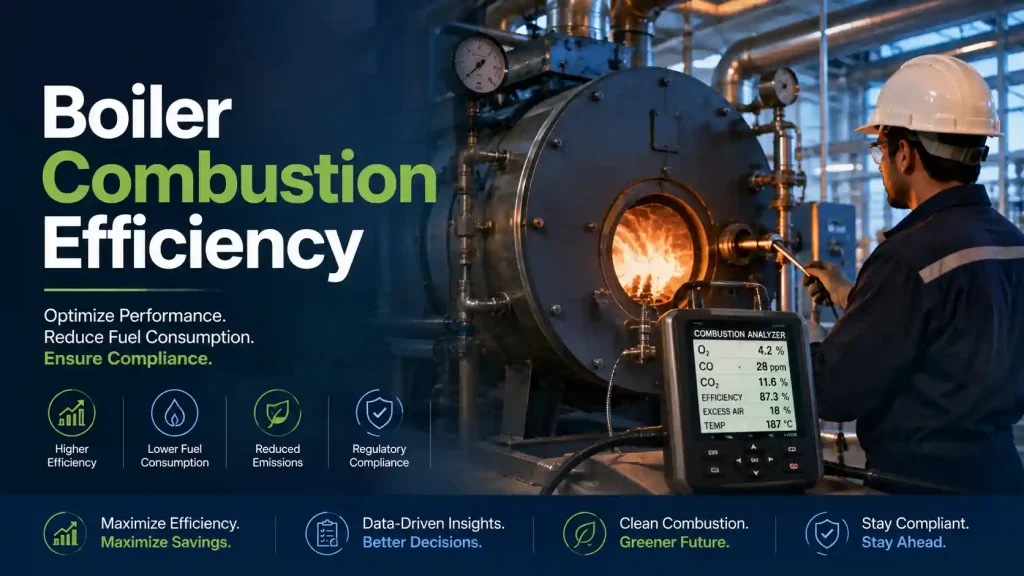
Combustion efficiency only looks at the heat lost in the flue gas, while boiler efficiency counts every loss. A combustion analyser measures O₂ or CO₂, CO, and flue temperature, then calculates combustion efficiency for the fuel you select. That figure ignores shell radiation, blowdown, ash losses and standby losses, so it is always higher than true boiler efficiency.
Combustion efficiency is still the most useful daily number. It reacts within seconds to a damper change, so it is the right tool for tuning. Boiler efficiency is the right number for audits and for comparing boilers.
How can you improve boiler efficiency?
Start with the flue gas: hold O₂ at the lowest level that keeps CO low, and bring flue gas temperature down.
- Tune the air-to-fuel ratio. Reduce air in small steps while watching CO. Stop just before CO starts to rise. This cuts L1 without adding L5.
- Control O₂ continuously. Fuel quality and load change through the day. An online O₂ signal in a closed loop with the burner controller keeps the ratio right all the time. This is especially useful when fuel quality varies, for example gas from different sources or coal from different mines.
- Bring down flue gas temperature. Clean soot and scale from heat transfer surfaces and recover heat with an economiser or air preheater. In the L1 example above, cutting flue gas temperature from 190°C to 170°C drops the loss from 8.0% to 7.0%, a full point of efficiency.
- Fix air ingress. Leaks in the flue add air after the burner, which raises O₂ readings and hides the real combustion picture.
- Check unburnt carbon. For coal-fired boilers, test fly ash and bottom ash regularly. High carbon in ash is fuel you paid for and threw away.
- Insulate. Repair damaged lagging on the shell, headers, and steam lines to cut L6.
Better combustion also lowers emissions. Before you change fuel or burner settings, check your stack against the boiler stack emission limits for your capacity and fuel.
Which instruments do you need for a boiler efficiency test?
For the indirect method, you need flue gas analysis, temperatures, and a fuel analysis. For the direct method, you need steam, feed water, and fuel flow.
| Measurement | Instrument | From our range |
| O₂, CO, CO₂ and flue gas temperature | Portable combustion analyser (exhaust gas analyser) | KANE 458s, KANE 958, KANE 988 |
| Continuous O₂ for burner trim | In-situ zirconia oxygen analyser | OXY600 |
| Draught | Pressure meter | COMARK C9555 |
| Steam, water and fuel flow | Flow meters | Plant instruments |
| GCV, moisture, hydrogen, ash | Fuel analysis | Accredited fuel laboratory |
| Unburnt carbon | Ash analysis | Accredited laboratory |
Not sure which combustion analyser suits your boiler? Our flue gas analyser explainer compares sensor types, gases, and the KANE models side by side.
How Nevco helps
Nevco Engineers began in 1982 as Combustion Analysers, and we have been measuring boiler flue gas for 44 years. We were adjudged the winner in the Energy Efficient Technology Provider category of the CII National Energy Efficiency competition. Our engineers supply portable KANE analysers for tuning and audits, the OXY600 for continuous O₂ control, and full stack monitoring where your consent needs it.
Want to know your boiler’s real efficiency?
Our engineers can test your boiler with a calibrated combustion analyser and show you which losses to tackle first. Call +91-9999946668 or write to sales@nevcoengineers.com, Monday to Saturday, 10:00 AM to 6:00 PM.
Frequently asked questions
What is the formula for boiler efficiency?
By the direct method, boiler efficiency (%) = steam flow × (steam enthalpy − feed water enthalpy) ÷ (fuel flow × GCV) × 100. By the indirect method, boiler efficiency (%) = 100 − the sum of all heat losses. The indirect method is preferred for audits because it shows where heat is lost.
How do you calculate boiler efficiency by the indirect method?
Measure flue gas O₂, CO, and temperature, ambient temperature and humidity, and get a fuel analysis with GCV, moisture, hydrogen, and ash. Calculate each loss, from dry flue gas and moisture through to unburnt carbon, as a percentage of fuel heat. Add them up and subtract the total from 100.
What is a good boiler efficiency?
It depends on fuel and boiler type. Gas- and oil-fired boilers generally reach higher efficiency than coal or biomass boilers, because their fuels have little moisture or ash and burn with less excess air. Compare your figure with the manufacturer’s design efficiency at the same load, not with a general number.
Which loss is the biggest in a boiler?
Dry flue gas loss is usually the largest single loss. It rises with flue gas temperature and with excess air. Measuring O₂ and flue temperature with a combustion analyser, then reducing excess air and recovering exhaust heat, is the quickest way to cut it.
What is the difference between a combustion analyser and an exhaust gas analyser?
In boiler work, they are the same type of instrument. Both draw a sample of flue gas, measure O₂, CO, and other gases, and read flue temperature. “Combustion analyser” stresses the efficiency calculation, while “exhaust gas analyser” is used more for engines and emissions checks.
How does excess air affect boiler efficiency?
Excess air must be heated from ambient to flue gas temperature and then leaves through the stack, taking that heat with it. Too much excess air raises dry flue gas loss. Too little causes incomplete combustion and CO. The best setting is the lowest O₂ that keeps CO low.