Quick answer: The CGWA Guidelines 2020 are the Central Ground Water Authority’s rules for drawing groundwater in India, notified by the Ministry of Jal Shakti as S.O. 3289(E) on 24 September 2020. Industries, infrastructure, and mining projects need a CGWA NOC to extract groundwater. Every NOC holder must fit a tamper-proof digital water flow meter with telemetry on each borewell, report it within 30 days of the NOC, and calibrate it every year.
Key takeaways
- CGWA full form: Central Ground Water Authority, set up on 14 January 1997 under Section 3(3) of the Environment (Protection) Act, 1986.
- Industries, infrastructure projects, mining projects, bulk water suppliers and other commercial users need a CGWA NOC. Agriculture, individual domestic users, rural drinking water schemes, the armed forces and micro and small enterprises drawing under 10 m³/day are exempt.
- A digital flow meter with telemetry is mandatory for every NOC holder. A missing or faulty meter carries a penalty of Rs 2,00,000.
- Projects drawing more than 10 m³/day must build piezometers, with digital water level recorders above 50 m³/day.
- Industries drawing more than 100 m³/day need an annual water audit by a CII, FICCI or NPC certified auditor.
What is CGWA, and what do the CGWA guidelines 2020 cover?
CGWA stands for Central Ground Water Authority. It was constituted on 14 January 1997 (S.O. 38(E)) under the Environment (Protection) Act, 1986, to regulate and control groundwater development and management in India. It works under the Department of Water Resources, River Development and Ganga Rejuvenation, Ministry of Jal Shakti.
The CGWA guidelines 2020, formally the “Guidelines to regulate and control groundwater extraction in India”, were notified on 24 September 2020 as S.O. 3289(E). They replaced the December 2018 guidelines (S.O. 6140(E)), whose implementation the National Green Tribunal stayed on 3 January 2019. They cover:
- who needs a No Objection Certificate (NOC) to draw groundwater, and who is exempt
- conditions in every NOC, including flow meters, telemetry, rainwater harvesting and recharge
- groundwater abstraction and restoration charges
- piezometers and water level monitoring
- water audits and impact assessment reports
- NOC validity, renewal and transfer
- environmental compensation and penalties for violations
On 29 March 2023, CGWA amended the guidelines through S.O. 1509(E). The changes added two exemptions, made online water audit reports compulsory for commercial users, and tightened the rules for bulk water suppliers and saline groundwater.
One note on jurisdiction: CGWA regulates groundwater in states and union territories that have not set up their own authority. Some states issue their own permissions. For example, Haryana cases go to the Haryana Water Resources Authority (HWRA) and Punjab cases to the Punjab Water Regulation and Development Authority. Check which authority covers your site before you apply.
Who needs a CGWA NOC?
Any industry, infrastructure project, mining project, or commercial user drawing groundwater needs a CGWA NOC, unless an exemption applies. The guidelines state that commercial extraction by these users without a valid NOC is illegal.
| Needs a CGWA NOC | Exempt from NOC |
|---|---|
| Industries (new, existing and expanding) | Agricultural activities |
| Infrastructure projects, including dewatering during construction | Individual domestic consumers in rural and urban areas, for drinking and domestic use |
| Mining projects, including mine dewatering | Rural drinking water supply schemes |
| Bulk water suppliers and private tankers | Armed Forces and Central Armed Police Forces establishments |
| Other commercial users, such as packaged drinking water units, hotels and hospitals | Micro and small enterprises drawing less than 10 m³/day |
| Industries, mining and infrastructure projects drawing groundwater only for drinking or domestic use, up to 5 m³/day (added in 2023) | |
| Residential apartments and group housing societies (added in 2023) |
Being exempt from the NOC does not mean being exempt from metering. CGWA’s public notice of 8 January 2021 asks micro and small enterprises drawing under 10 m³/day to fit digital water flow meters on all abstraction structures too, and says they are subject to random inspections.
What are the CGWA flow meter and telemetry requirements?
Every NOC holder must install a tamper-proof digital water flow meter with telemetry on every abstraction structure, tell CGWA within 30 days of getting the NOC, and have the meter calibrated once a year by an authorised agency. This comes from Section 9.0(i) and (ii) of the guidelines and CGWA’s public notice of 8 January 2021.
The key rules:
- Every borewell, tube well, or abstraction point needs its own meter, not one meter for the whole site.
- Tamper-proof, with telemetry. The 8 January 2021 notice says drawing groundwater without the required meter will be treated as illegal.
- Report the installation to CGWA through the web portal within 30 days of the NOC being granted.
- Calibrate annually through an authorised agency, and keep the certificate.
- Existing users: CGWA’s public notice of 17 June 2021 set 31 March 2022, or the date in the NOC if later, as the last date for all groundwater users to fit tamper-proof digital meters.
What does a CGWA-compliant flow meter need?
CGWA has published a specification for “Digital Water Flow Meter with Telemetry for Groundwater extraction monitoring”. The main points:
| Requirement | CGWA specification |
|---|---|
| Meter type | Ultrasonic or electromagnetic, preferably made to ISO 4064:2014 |
| Accuracy | ±2% from 10% to 100% of maximum flow, turndown ratio of 10 or more |
| Calibration | At least four points (10%, 40%, 70% and 100%), by an ISO 17025:2017 lab |
| Protection | IP68 |
| Tamper-proofing | Mechanical and software seals, tags that break if the enclosure is opened, tamper alarms to the server, encrypted communication |
| Reverse flow | Recorded separately |
| Telemetry | LAN, LoRaWAN or cellular (GPRS, 3G or 4G), at least twice a day |
| Data stored on the meter | Daily flow data with timestamps for at least 2 years; data sent later if telemetry fails |
| Battery | At least 3 years at two transmissions a day, replaceable without data loss |
| Data sent | Timestamp, forward, reverse, and net volume, pump working hours, meter serial number, last calibration date, and the CGWA borewell ID |
| Where data goes | A secure cloud from a MeitY-empanelled provider, then to CGWA’s real-time platform |
A loss of communication must show on the server within 48 hours. That is why a meter that quietly stops transmitting is a compliance problem, not just a maintenance one. We explain the usual causes and fixes in borewell meter telemetry failure: risks, penalties and fixes.
Do you need piezometers under the CGWA guidelines?
Yes, if you draw more than 10 m³/day. Section 14.0 sets the number of piezometers, which are observation wells for tracking the groundwater level, by daily withdrawal:
| Groundwater withdrawal (m³/day) | Piezometers | Monitoring |
|---|---|---|
| Less than 10 | None | None |
| 11 to 50 | 1 | Manual |
| 51 to 500 | 1 | Digital water level recorder (DWLR) |
| More than 500 | 2 | 1 with DWLR and 1 with DWLR and telemetry |
Water level data must be submitted to CGWA through its web portal.
What other conditions come with a CGWA NOC?
Beyond meters and piezometers, the NOC carries conditions on recharge, audits, reports and water reuse.
- Rainwater harvesting and recharge: rooftop rainwater harvesting and recharge structures are compulsory in the project area (Section 9.0(iii)).
- Abstraction charges: you pay groundwater abstraction or restoration charges based on the volume you extract and your area’s category (Section 9.0(iv)).
- Water audit: industries drawing more than 100 m³/day need an annual water audit through CII, FICCI or NPC-certified auditors. They must also cut groundwater use by at least 20% over the following three years. Since 2023, every commercial entity must submit an online water audit report.
- Impact assessment: industries drawing more than 100 m³/day in over-exploited, critical or semi-critical areas must submit an impact assessment and socio-economic report by an accredited consultant.
- Wastewater: injecting treated or untreated wastewater into the aquifer is banned.
- Greenbelt water: use recycled or treated wastewater where feasible.
- Change of ownership: the new owner must apply for changes within 60 days of taking possession.
How long is a CGWA NOC valid?
Validity depends on the user type and the area’s groundwater category. Under Section 11.0:
| User | Safe, semi-critical and critical areas | Over-exploited areas |
|---|---|---|
| Infrastructure for drinking and domestic use, urban water supply agencies | 5 years | 2 years |
| Industries | 3 years | 2 years |
| Mines | 2 years | 2 years |
Apply for renewal at least 90 days before expiry. If you have not applied within 3 months of the expiry date, you become liable for environmental compensation from expiry until renewal.

How do you apply for a CGWA NOC on NOCAP?
Applications are made online. CGWA’s No Objection Certificate Application Portal (NOCAP) at cgwa-noc.gov.in has handled NOC applications since the 2020 guidelines. In 2024, the ministry launched Bhu-Neer, developed by CGWA and NIC as an upgraded successor to NOCAP, with a PAN-based single ID and QR-coded NOCs. Check the portal for the current route before you apply.
The usual steps:
- Check your area category (safe, semi-critical, critical, or over-exploited) on the portal.
- Register as a project proponent and complete the application with your site details, abstraction structures, and water demand.
- Upload documents such as the site plan, groundwater quality data for existing users, the water balance, and, where required, the impact assessment or hydrogeological report.
- Pay the fees. The portal lists a processing fee of Rs 10,000 for a fresh NOC and Rs 5,000 for a renewal, plus advance abstraction charges and any penalty.
- Receive the NOC and meet its conditions: meters, telemetry, piezometers, and recharge, each with its own reporting date.
- Report compliance through the portal, including the meter installation within 30 days.
What are the penalties under the CGWA guidelines?
Penalties are fixed amounts for each violation, on top of any environmental compensation for illegal extraction. Selected items from Table 16.1:
| Violation | Penalty |
|---|---|
| Injecting treated or untreated water into the aquifer | Rs 10,00,000, plus cost of remediation |
| Recharge structures not built or of inadequate capacity | Rs 5,00,000 |
| Digital flow meter with telemetry not installed or faulty | Rs 2,00,000 |
| Piezometer not installed | Rs 2,00,000 |
| DWLR or telemetry system not installed or faulty | Rs 1,00,000 |
| Water level or water quality data not submitted | Rs 50,000 |
| Withdrawal log book not kept or abstraction data not submitted | Rs 50,000 |
Under Section 10.0, District Collectors and District Magistrates can also seal abstraction structures, cut the electricity supply, start prosecution and levy environmental compensation. Non-compliance can also lead to the NOC being cancelled.
Key dates at a glance
| Date | What happened |
|---|---|
| 14 January 1997 | CGWA constituted (S.O. 38(E)) |
| 12 December 2018 | Earlier guidelines notified (S.O. 6140(E)); stayed by the NGT on 3 January 2019 |
| 24 September 2020 | CGWA guidelines 2020 notified (S.O. 3289(E)); abstraction charges apply from this date |
| 8 January 2021 | Public notice: tamper-proof digital flow meters with telemetry on all abstraction structures |
| 17 June 2021 | Public notice: meters for all users by 31 March 2022 (or the NOC date, if later); Rs 1 lakh penalty for existing users who missed the 30 June 2020 NOC deadline |
| 31 March 2022 | Last date for meters, water audit reports and impact assessment reports under the 2021 relaxation |
| 29 March 2023 | Amendment S.O. 1509(E): new exemptions, online water audit for commercial users |
| 2024 | Bhu-Neer portal launched as the successor to NOCAP |
Common mistakes plants make with CGWA compliance
- One meter for the whole site. Each abstraction structure needs its own meter.
- A meter without telemetry. A digital display alone does not meet the NOC condition.
- Forgetting the 30-day report. The meter can be in place, and the plant still be in breach because CGWA was never told.
- Skipping annual calibration. Keep the certificate from an authorised agency on file.
- Letting telemetry lapse. A dead SIM or flat battery means missing data, and a faulty meter carries the same Rs 2,00,000 penalty as no meter.
- Applying for renewal late. Apply 90 days before expiry to avoid environmental compensation.
Need a CGWA-compliant flow meter for your borewell?
Nevco supplies flow meters for borewell and process water metering, with installation and calibration support:
- Electromagnetic flow meter for full pipelines carrying conductive liquids, with no moving parts and very low pressure loss. Get a quote
- Ultrasonic clamp-on flow meter that clamps onto the outside of an existing pipe, so the pipe does not need cutting. Get a quote
- Open channel flow meter for discharge channels and drains.
See the full range on our flow meter solutions page. When you ask for a quote, tell us the pipe size, flow range, number of borewells, and whether you need telemetry, and we will check the meter against the CGWA specification above.
How Nevco helps
Nevco Engineers has supplied environmental and water monitoring instruments to Indian industry for 44 years, since 1982. Our 60+ sales and service engineers across India help plants choose, install, and maintain flow meters for groundwater and effluent metering, and fix meters that have stopped reporting.
We have solution to what has been asked and details can be seen on Catalogue
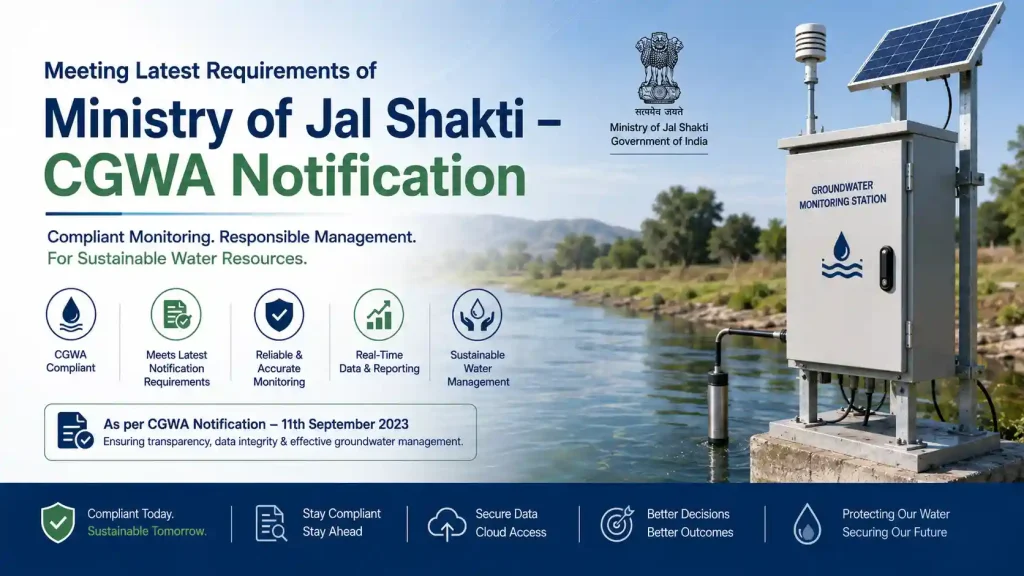
Please see highlighted portion of below notification.
CGWA Notification of 24 September 2020
CGWA Notification of 26 October 2020
Need a meter that meets your CGWA NOC conditions? Send us your borewell count, pipe sizes, and NOC conditions, and our engineers will recommend and quote the right flow meter with telemetry. Call +91-9999946668 or write to sales@nevcoengineers.com, Monday to Saturday, 10:00 AM to 6:00 PM.
Frequently asked questions
What is the full form of CGWA?
CGWA stands for Central Ground Water Authority. It was constituted on 14 January 1997 under Section 3(3) of the Environment (Protection) Act, 1986, to regulate and control groundwater development in India. It works under the Department of Water Resources, Ministry of Jal Shakti.
What are the CGWA guidelines 2020?
They are the “Guidelines to regulate and control groundwater extraction in India”, notified on 24 September 2020 as S.O. 3289(E). They set out who needs a groundwater NOC, the conditions attached to it (meters, telemetry, piezometers, recharge, water audits), abstraction charges, NOC validity, and penalties. They were amended on 29 March 2023.
Who needs a CGWA NOC?
Industries, infrastructure projects, mining projects, bulk water suppliers, and other commercial users that draw groundwater need a CGWA NOC. Agriculture, individual domestic users, rural drinking water schemes, the armed forces, micro and small enterprises drawing under 10 m³/day, and, since 2023, residential societies are exempt.
What is NOCAP in CGWA?
NOCAP is the No Objection Certificate Application Portal, CGWA’s online system for applying for, renewing, and tracking groundwater NOCs at cgwa-noc.gov.in. In 2024, the Ministry of Jal Shakti launched Bhu-Neer as its upgraded successor, with a PAN-based single ID and QR-coded NOCs.
Is a flow meter with telemetry mandatory under the CGWA guidelines?
Yes. Section 9.0(i) makes a digital water flow meter with telemetry mandatory for every NOC holder, on every abstraction structure. Installation must be reported within 30 days of the NOC, and the meter must be calibrated once a year. A missing or faulty meter carries a penalty of Rs 2,00,000.
How long is a CGWA NOC valid?
In safe, semi-critical, and critical areas, an NOC is valid for 5 years for drinking water infrastructure and urban supply agencies, 3 years for industries, and 2 years for mines. In over-exploited areas, it is valid for 2 years. Apply for renewal 90 days before expiry.