
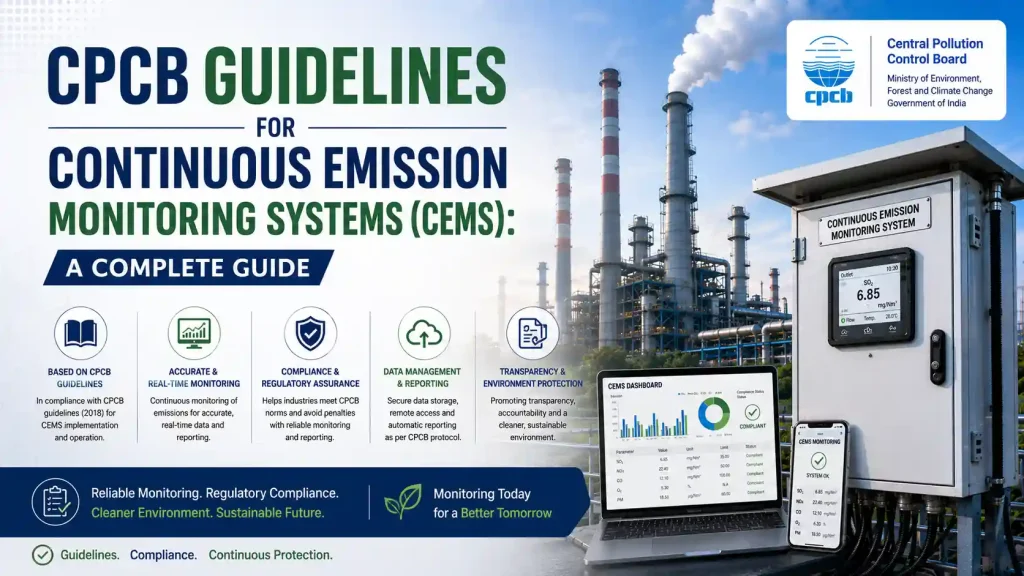
Quick answer: The CPCB guidelines for CEMS are the Central Pollution Control Board’s rules for continuous emission monitoring systems on industrial stacks. The current base document is the 1st Revised Guidelines for Continuous Emission Monitoring Systems (August 2018). It sets which parameters each industry monitors, where analysers go, how data is corrected and sent to CPCB, and how systems are calibrated, with at least 85% data capture. CPCB updated the calibration schedule on 29 July 2025, and since 31 August 2025 data has gone to CPCB through ODAMS.
Key takeaways
- The CPCB CEMS guidelines apply to the 17 categories of highly polluting industries, common biomedical and hazardous waste incinerators, and boilers covered by G.S.R. 96(E) of 29 January 2018.
- Parameters depend on the industry: cement monitors PM, NOx and SO₂; fertiliser monitors PM, HF and ammonia; thermal power adds gaseous mercury.
- Results must be corrected for moisture and to the reference O₂ or CO₂ level in your standard. CPCB does not accept uncorrected data.
- Data must flow straight from the analyser to CPCB and the state board, with no manual handling, and with at least 85% data availability.
- A breakdown must be fixed within 72 hours, or the plant must cut back or shut down the process the stack serves.
Download the CPCB guidelines PDF: 1st Revised Guidelines for Continuous Emission Monitoring Systems, CPCB, August 2018 (PDF)
What are the CPCB guidelines for CEMS?
They are CPCB’s technical rules for installing, calibrating and reporting from continuous emission monitoring systems in India. They grew out of three steps.
- 2014 directions. CPCB directed, under Section 18(1)(b) of the Water and Air Acts, that the 17 categories of highly polluting industries, CETPs, STPs and common biomedical and hazardous waste incinerators install online emission and effluent monitoring and send the data to the state boards and CPCB.
- 2017 guidelines. CPCB issued its first Guidelines for Continuous Emission Monitoring Systems in August 2017. The idea behind them was simple. Inspections alone cannot keep up with industrial growth, so industries monitor themselves continuously, at their own cost under the “polluter pays” principle, and the regulator checks the data.
- 2018 revision. CPCB published the 1st Revised Guidelines for Continuous Emission Monitoring Systems in August 2018. This remains the base document for stack CEMS.
Alongside these, the Centre for Science and Environment (CSE) published a technical guidance manual on CEMS that compares Indian practice with Europe and the US, and covers technology options, certification and data checks.
Which industries must follow the CPCB CEMS guidelines?
Three groups are covered.
- The 17 categories of highly polluting industries: aluminium, cement, chlor alkali, copper, distillery, dyes and dye intermediates, fertiliser, integrated iron and steel, oil refinery, pesticides, petrochemicals, pharmaceuticals, pulp and paper, sugar, tanneries, thermal power and zinc.
- Common biomedical and hazardous waste incinerators.
- Boilers under G.S.R. 96(E), 29 January 2018, in industries such as sugar, cotton textile, composite woollen mills, synthetic rubber, pulp and paper, distilleries, leather and carbon black.
Your Consent to Operate is the final word on which stacks and parameters apply to you. For the difference between stack, effluent and ambient systems, see OCEMS full form: OCEMS vs CEMS vs CEQMS vs CAAQMS.
What parameters do the CPCB norms require for each industry?
Annexure I of the 2018 guidelines lists the stack parameters by industry.
| Industry | Stack parameters |
|---|---|
| Aluminium | PM, fluoride |
| Cement | PM, NOx, SO₂ |
| Chlor alkali | Cl₂, HCl |
| Copper | PM, SO₂ |
| Distillery | PM |
| Fertiliser | PM, HF, ammonia |
| Iron and steel | PM, SO₂, NOx |
| Oil refinery | PM, CO, NOx, SO₂ |
| Petrochemical | PM, CO, NOx, SO₂ |
| Power plants | PM, NOx, SO₂; thermal power plants also total gaseous mercury |
| Zinc | PM, SO₂ |
| Boilers | PM, SO₂, NOx |
Every stack also needs the supporting measurements that make the results comparable: temperature, flow (where the standard is load based), a diluent gas (O₂ or CO₂), moisture where needed and absolute pressure. Incinerators also monitor CO, and their stacks need real-time moisture monitoring. The emission limits themselves come from the industry-specific standards in your consent. For boilers, see boiler emission limits in India by industry.
Where must CEMS be installed on the stack?
At a point where the gas flow is steady, so the reading represents the whole stack. The 2018 guidelines set these rules:
- Straight run: at least 8 stack diameters downstream and 2 diameters upstream of any bend, damper or flow disturbance.
- Flow conditions: gas flow angle under 15°, velocity above 3 m/s, and a highest-to-lowest local velocity ratio under 3:1.
- PM CEMS position: 500 mm vertically below the manual sampling port, with a horizontal shift of 30 to 50 cm allowed, so manual and continuous sampling see the same gas.
- Measuring range: for PM, 2.5 to 3 times the emission standard. A 50 mg/Nm³ standard needs a range of 0 to 125 or 0 to 150 mg/Nm³.
- Response time: under 200 seconds.
- Older stacks: stacks more than 15 years old may be relaxed from the location rules if the state board certifies the reasons.
The guidelines also match PM technology to stack conditions. In-situ systems suit flue gas above dew point (above about 95°C). Wet stacks with water droplets, such as after a wet scrubber or wet FGD, need extractive systems or beta attenuation. Opacity monitors do not suit low dust levels or wet gas. If you are choosing between methods, read choosing the right CEMS method.
How must CEMS data be corrected and reported?
All data must be corrected and normalised before it is compared with the standard, and it must reach the regulator without anyone touching it.
Correction
- Moisture: emissions are reported on a dry basis, using real-time moisture values or verified manual values.
- Reference oxygen or CO₂: results are corrected to the level in your standard. Annexure II gives the formulas, for example:
- Correction to 11% O₂: corrected value = measured value × (20.9 − 11) ÷ (20.9 − measured O₂)
- Correction to 12% CO₂: corrected value = measured value × 12 ÷ measured CO₂
- Units: ppmv to mg/Nm³ uses mg/Nm³ = ppm × molecular weight ÷ 24.45.
- Dilution systems: report the dilution ratio as a separate parameter, and measure CO₂ at both the stack and the analyser end.
CPCB’s 2018 compliance reporting protocol made the point bluntly: CPCB will not accept data that has not been corrected to O₂ or CO₂ and normalised to standard temperature and pressure, and this applies to analysers already installed.
Data acquisition and transmission
- Data is collected in real time with no human intervention. Manual data handling is not allowed at any point.
- Data goes straight from the analyser end to the server, with no intermediate PC or plant server, in encrypted, tamper-proof form, using a REST-based open API.
- The system sends 15-minute average values and transmits to at least four locations, including CPCB and the state board.
- Data must be stored for five years, and the analyser must hold at least one year of data in non-volatile memory.
- Configurations, once verified, must not change without approval from the state board.
- The responsibility for data submission lies with the individual unit, not the vendor.
Where data goes now: ODAMS
Since 31 August 2025, CEMS data goes to CPCB through its ODAMS (Online Data Acquisition and Management System) portal. Each unit must register directly and map every stack and parameter. Registration on the old OCEMS portal alone no longer counts, as we explain in ODAMS registration: CPCB rules and closure risk.
In Delhi NCR, only CSIR-NPL certified analysers may send stack data to the government server. See which stack analysers are CSIR-NPL certified for CPCB in NCR.
What are the CPCB calibration requirements for CEMS?
The 2018 guidelines set the calibration rules, and CPCB revised the schedule on 29 July 2025. Use the 2025 schedule as current, and the 2018 guidelines for the procedures behind it.
| System | 2018 guidelines | Revised schedule, 29 July 2025 |
|---|---|---|
| Gaseous CEMS: zero and span | Fortnightly (second Friday of the fortnight, 10:00 a.m.); daily zero drift check; recalibrate if drift lasts five days | Two-point (zero and span) checks in-house, fortnightly |
| Gaseous CEMS: multipoint | At least 3 span concentrations, after six months | Multipoint checks every three months |
| Gaseous CEMS: lab verification | Data comparison by empanelled labs once in six months | Performance test by an authorised lab, annually |
| PM CEMS | Calibrated at three operating loads against isokinetic sampling (nine samples) at installation and every 12 months; monthly comparison; recalibrate if the dust factor deviates by more than 10% in two consecutive checks | In-house checks every three months; third-party performance test annually |
| Effluent analysers (pH, temperature) | Not covered in the stack guidelines | In-house checks fortnightly; accredited lab verification annually |
| Effluent analysers (BOD, COD, TOC, TSS) | Not covered in the stack guidelines | In-house checks monthly; third-party performance test annually |
| All systems | Recalibrate after major repair, lamp change or realignment | Recalibrate after major repair, component change or realignment |
Two rules from 2018 still apply in full: ambient air must not be used for zero or span calibration, and spectroscopic analysers (DOAS, NDUV, NDIR, laser and FTIR) must be revalidated after a lamp change. Use CPCB-empanelled, EPA-approved or NABL-accredited labs, and have performance audits done by a different empanelled lab from the one that does routine calibration.
What data capture do the CPCB norms demand?
At least 85% data availability. The 2018 guidelines also define when data counts as lost:
- More than 10 minutes missing in a half hour makes that half hour invalid.
- More than 5 invalid half hours in a day, or more than 3 invalid hourly averages, makes it a lost day.
- Calibration and maintenance periods are excluded from exceedance and capture calculations, and so are shutdowns.
- For batch or intermittent processes, the first 30 minutes after start-up are excluded from averaging.
- If a breakdown is not fixed within 72 hours, the plant must reduce or shut down operation.
- Spare parts must be available for at least 7 years.
Is your plant CPCB compliant? A quick checklist
Run your plant through these checks against your Consent to Operate:
- Every stack named in the consent has CEMS for every parameter in Annexure I and the consent.
- Analysers are installed at a location that meets the 8D/2D and flow rules, or the board has certified a relaxation.
- Results are corrected for moisture and to the reference O₂ or CO₂, and the dilution ratio is reported if you use a dilution system.
- Data goes directly to CPCB and the state board, with no intermediate server and no manual handling.
- The unit is registered on ODAMS, with every stack and parameter mapped.
- Zero and span checks run fortnightly, multipoint checks every three months, and the annual performance test is booked.
- PM CEMS has a current isokinetic calibration.
- Data availability is above 85%, and any breakdown is fixed within 72 hours.
- In Delhi NCR, analysers are CSIR-NPL certified.
- Calibration, maintenance, and lab comparison records are ready for inspection.
If you have already received a notice, follow our 15-day plan for a closure notice over missing OCEMS data.
CPCB guidelines PDF downloads
- 1st Revised Guidelines for Continuous Emission Monitoring Systems, August 2018 (PDF)
- CPCB Compliance Reporting Protocols, 2018 (PDF)
- CPCB Protocols for Online Continuous Effluent and Emission Monitoring Systems (PDF, cpcb.gov.in)
- CSE technical guidance manual on CEMS (cseindia.org)
Common mistakes with CPCB CEMS compliance
- Sending uncorrected data. Readings not corrected for moisture and reference O₂ or CO₂ are not accepted.
- Routing data through a plant server. The guidelines require direct transmission from the analyser end.
- Using ambient air for zero. Use zero air or nitrogen, never ambient air.
- Following the old calibration schedule. Multipoint calibration is now every three months, not six.
- Letting a breakdown run past 72 hours. After that, the plant is expected to cut back or stop.
- Registering on the old portal only. Data must now reach CPCB through ODAMS.
How Nevco helps
Nevco Engineers has supplied environmental monitoring systems to Indian industry for 44 years, since 1982. We supply, install, calibrate, and maintain CEMS that follow the CPCB guidelines:
- Gas analysers: the AR602Z UV spectrometer, LD500 laser cross-stack analyser, AR650 multi-component analyser and System 400.
- Dust monitors: stack and chimney dust monitoring systems, including the DSL-340 MKIII and Sintrol S300 series.
- Flow: the AccuFloQAL online flue gas flow monitor.
- Data: the NEVCO NV-LX IoT data logger, built to the CPCB communication protocol.
See the full range on our continuous emission monitoring page. For how manual stack sampling fits alongside CEMS, read stack monitoring: methods, frequency and reporting.
Not sure your CEMS meets the current CPCB guidelines? Our engineers can check your stacks, parameters, data correction, calibration records and ODAMS connection, and tell you what needs fixing. Call +91-9999946668 or write to sales@nevcoengineers.com, Monday to Saturday, 10:00 AM to 6:00 PM.
Frequently asked questions
What are the CPCB guidelines for CEMS?
They are the Central Pollution Control Board’s rules for continuous emission monitoring systems on industrial stacks. The current base document is the 1st Revised Guidelines for Continuous Emission Monitoring Systems, August 2018. It covers parameters by industry, installation location, data correction, direct data transmission, calibration, and data capture.
Where can I download the CPCB guidelines PDF?
You can download the August 2018 revised CPCB guidelines for CEMS from this page. We also link the 2018 CPCB compliance reporting protocol and CPCB’s protocol for online continuous effluent and emission monitoring systems. Check cpcb.gov.in for any later notifications.
Which industries must install CEMS under CPCB norms?
The 17 categories of highly polluting industries, common biomedical and hazardous waste incinerators, and boilers in industries covered by G.S.R. 96(E) of 29 January 2018 must install CEMS. Red category air-polluting units in Delhi NCR have also been directed to install online stack monitoring.
How often must CEMS be calibrated under CPCB rules?
Under CPCB’s revised schedule of 29 July 2025, gaseous CEMS need fortnightly zero and span checks, multipoint checks every three months and an annual performance test by an authorised lab. PM CEMS need in-house checks every three months and an annual third-party performance test.
What data capture rate does CPCB require?
The 2018 CPCB guidelines require at least 85% data availability. A half hour with more than 10 minutes missing is invalid, and a day with more than 5 invalid half hours is a lost day. A breakdown must be fixed within 72 hours, or the process must be reduced or shut down.
Does CPCB accept CEMS data that is not corrected?
No. CEMS data must be corrected for moisture and to the reference O₂ or CO₂ level in your standard, and normalised, before it is reported. CPCB’s compliance reporting protocol states that uncorrected and non-normalised data will not be accepted, including from analysers already installed.
What is the latest CPCB notification on online monitoring?
Key recent changes are the revised calibration schedule of 29 July 2025, the move to the ODAMS portal on 31 August 2025, and the rule that only CSIR-NPL-certified analysers may send stack data in Delhi NCR. Check cpcb.gov.in for anything issued since.